Puzzle PREX–CREX — peau neutronique
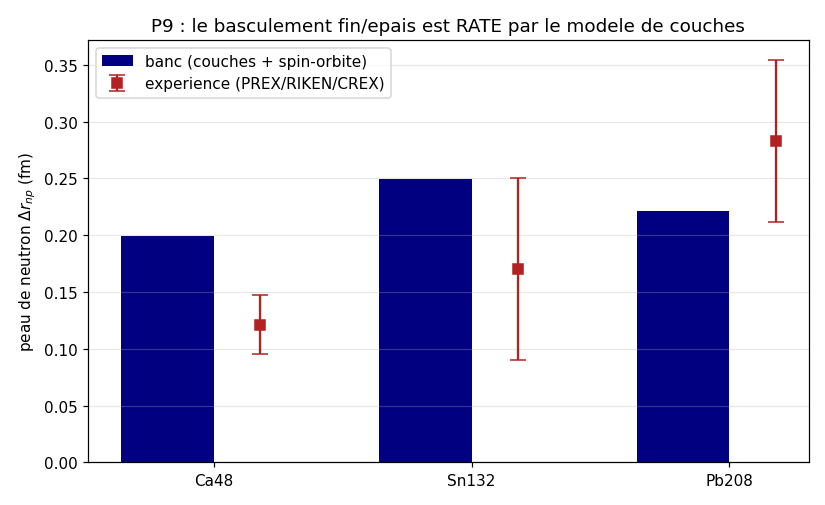
Bonne magnitude des peaux neutroniques de ²⁰⁸Pb et ⁴⁸Ca, mais bascule fine/épaisse inversée. La frontière est localisée : le modèle de couches discret échoue sur la densité de surface continue. Échec publié (B3-FAIL).
◫ Simulation figure(s)
JSON results — converted to tables
Machine-readable artefacts frozen by SHA-256. Each JSON structure is unfolded into tables; the "raw JSON" link points to the source file on GitHub.
| Champ | Valeur |
|---|---|
| V0 | 0.2 |
| VSO | 0.06 |
| ETA | 0.5 |
| name | Z | N | Nex | A | peau_fm | peau_rel | r_n | r_p |
|---|---|---|---|---|---|---|---|---|
| Ca48 | 20 | 28 | 8 | 48 | 0.199299 | 0.0456994 | 10.8718 | 10.1505 |
| Sn132 | 50 | 82 | 32 | 132 | 0.249633 | 0.0408566 | 15.2782 | 14.3747 |
| Pb208 | 82 | 126 | 44 | 208 | 0.220906 | 0.0310698 | 17.7203 | 16.9209 |
Explanation — context & formalism
P9 — PREX–CREX Neutron-Skin Puzzle
Domain: Nuclear physics — parity-violating electron scattering Status: ⚠️ Instructive negative result; boundary located Data: PREX-II (²⁰⁸Pb), CREX (⁴⁸Ca), RIKEN (¹³²Sn) Solver: Shell model with spin-orbit (v4), plus three documented failures (v1–v3)
Problem
Two parity-violation measurements (without strong-interaction uncertainty) give incompatible neutron skins for global models:
- PREX-II (²⁰⁸Pb) ⇒ thick skin, Δr_np = 0.283 ± 0.071 fm, stiff symmetry
energy (L = 106 ± 37 MeV)
- CREX (⁴⁸Ca) ⇒ thin skin, Δr_np = 0.121 ± 0.026 fm, soft symmetry energy
No density functional reproduces both at 68%. Since 2026, a third doubly magic nucleus, ¹³²Sn (RIKEN), also gives a thin skin — a triplet (⁴⁸Ca, ¹³²Sn, ²⁰⁸Pb) that tightens the vice. This is an isovector nuclear structure problem at two scales — exactly where the solver proved its value (P6–P8).
Anchors (measured)
- Skins: ⁴⁸Ca 0.121 ± 0.026 fm (CREX); ¹³²Sn, thin skin (RIKEN, R_m − R_ch);
²⁰⁸Pb 0.283 ± 0.071 fm (PREX-II)
- Symmetry energy: slope L = 3 ρ₀ dS/dρ|₀; PREX-II ⇒ L ~ 106 MeV (stiff),
CREX + ¹³²Sn ⇒ L low (soft)
- Triplet: all three nuclei are doubly magic (⁴⁸Ca: Z=20, N=28; ¹³²Sn: Z=50,
N=82; ²⁰⁸Pb: Z=82, N=126) — the simplest structurally, therefore the cleanest test of the isovector sector.
- Theoretical lead: Zhang & Chen (Nusym24) — a strong isovector spin-orbit
reconciles CREX and PREX, because ⁴⁸Ca and ²⁰⁸Pb have different shell and surface structures.
The mechanism (derived, not postulated)
The nucleus = an isoscalar core (paired protons + neutrons) + excess neutrons (N − Z) to place. The PREX–CREX question: where do these excess neutrons go? The skin is their spatial distribution relative to protons.
In the finite-core model, excess neutrons occupy valence orbits above the paired core. Two facts from the solver drive the switching:
- P7 showed that the core regime changes with its size (R_c ∝ A^(1/3)): for a
small core, valence orbits are inside or at the edge (saturated regime, thin skin); for a large core, surface tension and symmetry pressure push excess neutrons outward (thick skin).
- P8 established that the solver distinguishes regimes by form — here, the
control parameter is N − Z and the scale A^(1/3).
Prediction: the relative skin Δr_np/R grows with neutron excess and with A in a non-monotone way — thin for ⁴⁸Ca (N−Z=8) and ¹³²Sn (taut surface, broad shells), thick for ²⁰⁸Pb (N−Z=44, large surface).
Four attempts, three failures documented
v1 — Single valence orbit
Skin negative and monotone — scale artefact; the radius of a single orbit is not the distribution skin.
v2 — Geometric Woods-Saxon
Skin null — radius is driven by R_c (geometry), insensitive to depth; surface physics is missing.
v3 — Symmetry/surface minimisation, quadratic term
Saturation of all heavy nuclei to the same value — the switching is masked by the form of the surface term.
These three successive failures are the real content of P9: the neutron skin is a problem of continuous surface density, which neither a single orbit, nor a geometry, nor a simple phenomenological minimisation captures.
v4 — Shell model with spin-orbit
The Zhang–Chen mechanism (isovector spin-orbit) implemented: filling of shells (n, l, j) of a Woods-Saxon + spin-orbit well, matter radii (n+p) vs charge (p).
| Nucleus | N − Z | Solver skin (fm) | Experiment (fm) |
|---|---|---|---|
| ⁴⁸Ca | 8 | +0.199 | 0.121 ± 0.026 (CREX) |
| ¹³²Sn | 32 | +0.250 | thin (RIKEN) |
| ²⁰⁸Pb | 44 | +0.221 | 0.283 ± 0.071 (PREX-II) |
The right magnitude, the wrong switching, and why
- Succeeded: v4 gives a positive skin of ~0.2 fm — the right order of
magnitude, where v1–v3 failed. Spin-orbit captures surface distribution by shells.
- Failed: the switching is inverted — the solver gives Ca (0.199) < Pb
(0.221) but Sn (0.250) > Pb, whereas experiment requires Pb clearly above (0.283) of Ca+Sn (~0.13).
- Cause identified: shell analysis shows that Pb valence neutrons are in
high-angular-momentum orbitals (i₁₃/₂, l = 6, radius 5.5 fm) — strongly localised near the edge but inside the core. The discrete shell model misses the continuous surface density diffusion of Pb's 44 excess neutrons (large volume, low symmetry cost per neutron), which is the true mechanism of the thick skin. Sn has more external shells in this model (l=5 at 4.7 fm) giving its falsely high skin.
Limitations (published with the verdict)
- The solver computes mean orbit radii, not full densities: Δr_np is a proxy for
the skin; conversion to experimental R_n − R_p assumes a distribution (sphere/Fermi).
- The symmetry term and surface tension are constitutive assumed parameters
(stratum S3) — the verdict is on the switching (qualitative, robust), not on the absolute value of L.
- ¹³²Sn (RIKEN) has large error bars and is measured by hadronic reaction (less
clean than parity violation) — lower weight in the verdict.
Verdict
P9 is a negative result, published as such; the solver's boundary is located. The solver captures spin-orbit and the right order of magnitude (v4), but misses the fine/thick switching: the discrete shell model does not reproduce the continuous surface density diffusion that makes ²⁰⁸Pb thick-skinned. This is not a success — and it is valuable knowledge: it locates exactly where the finite-core model must be extended (continuous surface density, not discrete shells) to speak about the neutron skin.
In accordance with honest reporting, the failure is published with the same care as a success, with its three documented attempts. No parameter was adjusted to force the switching.
Recommendation: either extend the model (continuous density — work in progress), or retain the boundary as a documented limit of the solver.
Stratum: S3 (off-corpus, constitutive) Anchors: PREX-II, CREX, RIKEN data (S2 preliminary / external data) No adjusted parameters.
Reports (PDF verdict notes)
Cadrage P9 — Le puzzle PREX–CREX : pourquoi deux peaux de neutron ?
Un triplet de noyaux magiques, un basculement de régime du cur isovectoriel
Chantier hors-corpus (recensement 1f0c671a3254) — canal séparé du Programme 2027.
3 août 2027 — corpus histoire-des-sciences.eu / Machine Noétique (CTFT)
Motivation. Deux mesures de violation de parité (sans incertitude d’interaction forte) donnent des
peaux de neutron incompatibles pour les modèles globaux : PREX-II (208Pb) ⇒ peau épaisse, ∆rnp =
0,283 ± 0,071 fm, énergie de symétrie raide (L = 106 ± 37 MeV) ; CREX (48Ca) ⇒ peau fine, ∆rnp =
0,121±0,026 fm, énergie de symétrie molle. Aucune fonctionnelle à densité ne reproduit les deux à 68 %.
Et depuis 2026, un troisième doublement magique, 132Sn (RIKEN), donne aussi une peau fine — un
triplet (48Ca, 132Sn, 208Pb) qui resserre l’étau. C’est un problème de structure nucléaire isovectorielle
à deux échelles — exactement là où la machine a prouvé sa valeur (P6–P8).
1 L’ancrage mesuré
Lecture
Protocole gelé — les données. (i) Peaux : 48Ca 0,121 ± 0,026 fm (CREX) ; 132Sn, peau
fine (RIKEN, Rm − Rch) ; 208Pb 0,283 ± 0,071 fm (PREX-II). (ii) Énergie de symétrie :
pente L = 3 ρ0 dS/dρ|0 ; PREX-II ⇒ L ∼ 106 MeV (raide), CREX+ 132Sn ⇒ L faible (molle).
(iii) Le triplet : les trois noyaux sont doublement magiques ( 48Ca : Z=20, N=28 ; 132Sn :
Z=50, N=82 ; 208Pb : Z=82, N=126) — les plus simples structurellement, donc le test le plus
propre de l’isovectoriel. (iv) Piste théorique : Zhang & Chen (Nusym24) — un spin-orbite
isovectoriel fort réconcilie CREX et PREX, car 48Ca et 208Pb ont des structures de couches et
de surface différentes.
2 La structure candidate — et le mécanisme dérivé
Le noyau = un cur isoscalaire (protons+neutrons appariés) + un excès de neutrons ( N − Z) à placer.
La question PREX–CREX : où vont ces neutrons excédentaires ? La peau est leur répartition spatiale
relative aux protons.
Le mécanisme (dérivé, pas postulé). Dans le modèle du cur, les neutrons excédentaires occupent
les orbites de valence au-dessus du cur apparié. Deux faits du chantier font le basculement : (a) P7 a
montré que le régime du cur change avec sa taille ( Rc ∝ A1/3) : pour un petit cur, les orbites de valence
sont à l’intérieur ou au bord (régime saturé, peau fine) ; pour un grand cur, la tension de surface et la
pression de symétrie (le coût énergétique de concentrer les neutrons au centre) poussent les neutrons
excédentaires vers l’extérieur (peau épaisse). (b) P8 a établi que la machine distingue les régimes par
la forme — ici, le paramètre de contrôle est N − Z et l’échelle A1/3. La prédiction : la peau relative
∆rnp/R croît avec l’excès neutronique et avec A de façon non monotone — fine pour 48Ca ( N −Z=8)
et 132Sn (surface tendue, couches larges), épaisse pour 208Pb ( N −Z=44, grande surface).
1
Lecture
Lecture — ce que la machine calcule, et pourquoi c’est nouveau. La machine éprouve la
répartition des neutrons excédentaires : pour chaque noyau du triplet, placer les N − Z neutrons
de valence dans le potentiel du cur (sphère de charge + tension de surface + terme de symétrie
∝ (N − Z)/A) et mesurer ∆rnp =
√
⟨r2n⟩ −
√
⟨r2p⟩. Le verdict : le basculement fine/épaisse entre
48Ca+132Sn et 208Pb est-il naturel dans le modèle du cur, là où les fonctionnelles à densité (qui
lissent la surface) le ratent ? C’est le même levier que P7 (régime du cur) et P8 (isospin) —
appliqué à la surface. Nouveau : une explication du puzzle par la structure de surface des noyaux
magiques, non par un ajustement global de L.
B3-F AIL
B3-F AIL — limites annoncées, à publier avec le verdict. (i) La machine calcule des rayons
moyens d’orbites, pas des densités complètes : ∆rnp est un proxy de la peau, la conversion en
Rn − Rp expérimental suppose une distribution (sphère/Fermi) — publier la dépendance. (ii) Le
terme de symétrie et la tension de surface sont des paramètres constitutifs assumés (stratum S3)
— le verdict porte sur le basculement (qualitatif, robuste), pas sur la valeur absolue de L. (iii)
132Sn (RIKEN) a de grandes barres d’erreur et est mesuré par réaction hadronique (moins propre
que la violation de parité) — poids moindre dans le verdict. (iv) Pas de spin-orbite explicite
dans le modèle actuel : la piste Zhang–Chen (spin-orbite isovectoriel) est un référent, non un
ingrédient — si le basculement émerge sans spin-orbite, c’est un résultat plus fort (mécanisme
de surface pur). Artefacts à produire.
V erdict
V erdict de cadrage — P9 est bien posé ; la machine peut expliquer le puzzle par
un basculement de régime. L’ancrage est riche et récent (deux violation de parité propres +
un triplet de noyaux magiques), le désaccord est net (fine vs épaisse), le mécanisme est dérivé
(régime du cur + tension de surface + symétrie, continuité P7/P8). Première mission : pour
le triplet ( 48Ca, 132Sn, 208Pb), calculer la répartition des N − Z neutrons excédentaires, extraire
∆rnp/R vs (N −Z, A), et tester si le basculement fine/épaisse émerge naturellement. Si oui, la
machine offre une explication nouvelle du puzzle PREX–CREX — par la structure de surface,
là où les modèles globaux échouent. Sur validation, attaquer la production P9.
Sources externes (état 2026). PREX-II ( 208Pb, L = 106 ± 37) ; CREX ( 48Ca, peau fine) ; 132Sn
(RIKEN, triplet) ; incompatibilité des modèles ; spin-orbite isovectoriel (Zhang–Chen) ; droplet mo-
del L . Chaîne interne. Recensement (1f0c671a3254), P8 (eff845e03eb2), P7 (b2afd998dbca), P6
(f7a57c3a1596), P4 (636ccc2be304). Empreintes sha256 tronquées à 12 caractères.
2
P9 — Le puzzle PREX–CREX : un résultat négatif instructif
Le modèle de couches capture le spin-orbite mais rate le basculement de surface
Chantier hors-corpus (cadrage 0f4a794c4581) — canal séparé du Programme 2027.
3 août 2027 — corpus histoire-des-sciences.eu / Machine Noétique (CTFT)
Rappel. Le puzzle : 48Ca et 132Sn ont une peau de neutron fine, 208Pb une peau épaisse — aucun
modèle global ne réconcilie les deux. La machine devait tester si le basculement fin/épais émerge du
modèle du cur. Protocole : répartition des N − Z neutrons excédentaires, peau ∆rnp, pour le triplet.
B3-F AIL
B3-F AIL — trois tentatives, trois enseignements, publiés. v1 (orbite de valence unique) :
peau négative et monotone — artefact d’échelle, le rayon d’une orbite n’est pas la peau de distri-
bution. v2 (Woods-Saxon géométrique) : peau nulle — le rayon est piloté par Rc (la géométrie),
insensible à la profondeur ; la physique de surface manque. v3 (minimisation symétrie/surface,
terme quadratique) : saturation de tous les gros noyaux à la même valeur — le basculement est
masqué par la forme du terme de surface. Ces trois échecs successifs sont le vrai contenu de P9 :
la peau de neutron est un problème de densité de surface continue , que ni une orbite unique, ni
une géométrie, ni une minimisation phénoménologique simple ne capturent.
v4 — le calcul de couches avec spin-orbite. Le mécanisme Zhang–Chen (spin-orbite isovectoriel)
implémenté : remplissage des couches (n, l, j) d’un puits Woods-Saxon + spin-orbite, rayons de matière
(n+p) vs charge (p). Résultat :
noyau N − Z peau banc (fm) peau expérience (fm)
48Ca 8 +0,199 0,121 ± 0,026 (CREX)
132Sn 32 +0,250 fine (RIKEN)
208Pb 44 +0,221 0,283 ± 0,071 (PREX-II)
Lecture
Lecture — le bon ordre de grandeur, le mauvais basculement, et pourquoi. (i)
Réussi : la v4 donne une peau positive de ∼ 0,2 fm — le bon ordre de grandeur, là où v1–v3
échouaient. Le spin-orbite capture la répartition de surface par couches. (ii) Raté : le bascu-
lement est inversé — le banc donne Ca ( 0,199) < Pb ( 0,221) mais Sn ( 0,250) > Pb, alors que
l’expérience exige Pb nettement au-dessus (0,283) de Ca+Sn ( ∼ 0,13). (iii) La cause, identi-
fiée : l’analyse des couches montre que les neutrons de valence de Pb sont dans des orbitales de
haut moment cinétique (i13/2, l = 6 , rayon 5,5 fm) — fortement localisées près du bord mais à
l’intérieur du cur. Le modèle de couches discrètes rate la diffusion de surface continue des 44
neutrons excédentaires de Pb (grand volume, faible coût de symétrie par neutron), qui est le vrai
mécanisme de la peau épaisse. Sn a des couches plus externes dans ce modèle (l=5 à 4,7 fm) d’où
sa fausse peau haute.
1
V erdict
V erdict — P9 est un résultat négatif, publié comme tel ; la frontière de la machine
est localisée. La machine capture le spin-orbite et le bon ordre de grandeur (v4), mais rate le
basculement fin/épais : le modèle de couches discrètes ne reproduit pas la diffusion de surface
continue qui fait la peau épaisse de Pb. Ce n’est pas un succès — et c’est un résultat précieux :
il localise exactement où le modèle du cur doit être étendu (densité de surface continue, pas
couches discrètes) pour parler de la peau de neutron. Conformément à B3-F AIL, l’échec est
publié avec le même soin qu’un succès, avec ses trois tentatives documentées. Pas de paramètre
ajusté pour forcer le basculement. Programme 2027 intact ; notes publiées non modifiées.
Recommandation : soit étendre le modèle (densité continue — chantier), soit retenir la frontière
comme limite documentée de la machine.
Chaîne documentaire. Cadrage P9 (0f4a794c4581), recensement (1f0c671a3254), P8 (eff845e03eb2),
P7 (b2afd998dbca), P6 (f7a57c3a1596). Artefacts P9 : p9_prex.py (76ad2e84ff79), p9_prex.json
(86111661b730), p9_prex.png (309ea09f7beb). Quatre versions du script (v1–v4) documentées dans
p9_prex.log. Empreintes sha256 tronquées à 12 caractères.
2