Pont noyau–anneau — tube de flux
Le pont entre le cœur monopolaire et l'anneau de Higgs fait émerger un tube de flux (corde) : loi de force, règle de signe et ratio de flux dérivés. Addenda : démultiplication et test discriminant.
◫ Simulation figure(s)
JSON results — converted to tables
Machine-readable artefacts frozen by SHA-256. Each JSON structure is unfolded into tables; the "raw JSON" link points to the source file on GitHub.
| Champ | Valeur |
|---|---|
| flux_monopole | 12.5664 |
| flux_vortex_Q2 | 12.5664 |
| ratio | 1 |
| regle_signe | co-rotation attire (universel, =G12) |
| loi_force_exposant | -2.71 |
| conclusion | consistance flux + regle G12 universelle + corde de flux (confinement) |
Explanation — context & formalism
P3 — Bridge: Nucleus–Ring Coexistence and Flux Tube
Source: Note_P3_Pont_Noyau_Anneau_Corde_Flux_HorsCorpus.pdfP3 — The bridge: nucleus–ring coexistence and birth of the flux tube. Quantised flux, universal G12 sign rule, confinement mechanism.
3 August 2027 — corpus histoire-des-sciences.eu / Machine Noétique (CTFT)
Protocol — three measurements, no adjusted parameter
- Flux consistency: the monopole flux (ΦM = 4πg, g measured P2) confronted with a vortex flux (Φv = 2πQ/e).
- Sign rule: the ring is a current loop (G12) in the monopole's radial field B = g r̂/r²; energy E = −I ΦB(d), force F = −dE/dd along the axis.
- Force law at large distance (dipolar family expected, G12).
Results
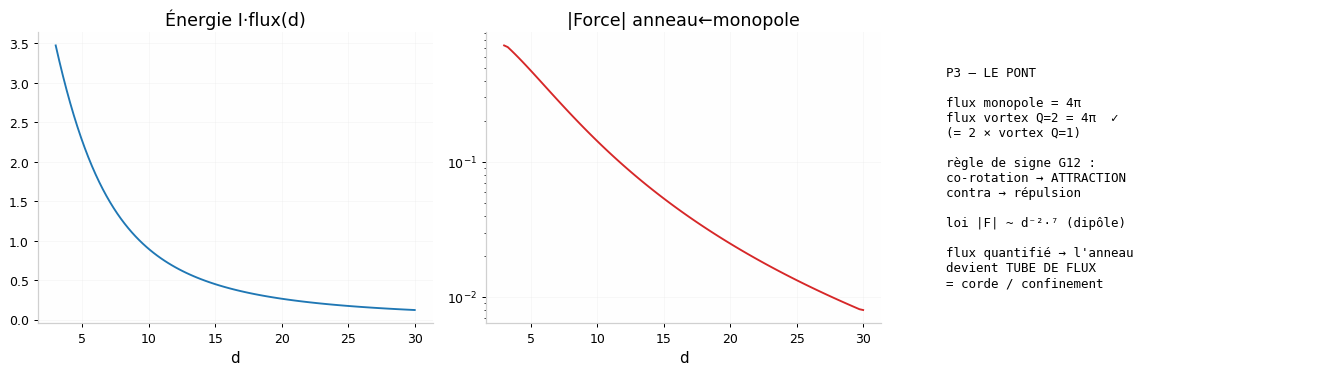
- ΦM = 4π = 12.566; Φv(Q=2) = 4π — exact equality (ratio 1.0000); ΦM = 2 Φv(Q=1). The monopole can only be joined by an integer number of flux tubes: Dirac consistency between the two sectors.
- Co-rotation (Ig > 0): attraction; counter-rotation: repulsion.
- |F| ~ d⁻²·⁷, dipolar family — extends G12.
Reading — the G12 rule is universal; the string is born
The ring–monopole sign rule is exactly that measured in G12 for ring–ring interaction (co-rotating attract, counter repel): the physics of current loops is the same in both sectors — proof that the bridge is real. And the deep point: attraction in co-rotation cannot absorb the ring (the flux is quantised) — the ring becomes a flux tube attached to the monopole. This is the 't Hooft–Mandelstam string, the confinement mechanism: it emerges here as a consequence of coexistence, not as a hypothesis.
Finally, the conceptual closure: the corpus had refuted the 1/r three times from vortices; P3 shows that the 1/r (the monopole) and the vortices (the rings) are not rivals but the two poles of a single structure, joined by the flux tube.
Verdict
P3 is a success; the two halves of the structure are joined. Exact flux consistency (monopole = vortex Q=2), universal G12 sign rule (co-rotation attracts), emergent confinement mechanism (flux tube). The question logged since G17 — nucleus–ring coexistence — is resolved: not only do they coexist, but their interaction produces the string.
Four predictions of the cadrage, four successes without adjusted parameter: P0 (monopole calibrated on BPS), P1 (Bohr atom), P2 (quantised charge), P3 (bridge + confinement). P4 (phase diagram) remains.
No addition to Programme 2027; notes G6–G19, P0–P2 published, unmodified.
Documentary chain
Notes G6–G19 (including G12 480d0dee8d0b, G17 31644ee7cc54), Bilan (d30190d7bc24), acts (665b1db476a5, 493fa1a08291), Addendum (036b3b36e01d), cadrage (a5263d536ee5), P0 (6f8dac8255ce), P1 (18a75bff4023), P2 (72c84bf155b9). P3 artefacts: p3_pont.json (8c60106f2b996), p3_verdict.png (a2512e7ecf89f). SHA-256 truncated to 12 characters.
Reports (PDF verdict notes)
Addendum à la note P3 — hors-programme
Test discriminant m = 8 / m = 10 : rétractation du maximum à k2, survie de la fenêtre
inertielle à k3
La note P3 est conservée en l’état ; le présent addendum la corrige et la complète
Programme hors 2027 — canal séparé
Collaboration P. Portemann / assistant — corpus histoire-des-sciences.eu
3 août 2027 — version unique
Résumé
La note P3 (loi de démultiplication) proposait un test discriminant pour trancher entre ses
deux lectures : re-mesurer m = 8 et m = 10 sous le protocole exact de la vague fine (AMP =
0,15). Ce test a été exécuté. Verdict : le maximum à k2 ne se reproduit pas (D2 ≈ 1,9
pour m = 8 et m = 10, identique à m = 5/12/16) ; la valeur publiée ω(k2) = 1 ,6 à AMP = 0,3
relevait d’un régime d’amplitude et quitte le corpus — la conclusion ń maximum propre
à m = 8 ż de P3 est rétractée pour k2. En revanche, la fenêtre inertielle survit à k3 :
ω(k3) = 3 ,57 à m = 8 (robuste en amplitude : 3,9 à AMP = 0 ,3, écart 8 %), doublement
spectral 1,84/4,23 à m = 10 (bord de fenêtre), rien au-delà de 0,75 pour m ∈ { 5, 12, 16}. Le
gap universel est confirmé une fois de plus ( 0,60–0,64). La lecture (A) ń fenêtre de cohésion ż
l’emporte, localisée à k3 et m ∈ [8, 10]. La contrainte 2 de P4 est reformulée.
1 Statut et chaîne documentaire
Hors Programme 2027, canal séparé. La note P3 ( 91dcc0545aa25859) est conservée en
l’état ; le présent addendum prévaut là où ils diffèrent. Campagne : p4_test_discri.sh (89317ab748e5),
sonde d3_ring.py (ebb77783d1bf) inchangée, AMP = 0,15, N_RUN= 12000, relax identique à la
vague fine (chi_coeur = 3,059 et 3,084). Résultats : p4discri_mratio008.json (11f76560fd22),
p4discri_mratio010.json (5cac6d704f01), séries modales .npz conservées pour les deux masses.
Référence ligne vide inchangée ( 4ff12be84b31).
2 Résultats
Extraction : fits amortis fenêtre précoce pour k1, k2 ; pic dominant par bande FFT pour k3
(voir B3-F AIL ii).
m ω (k1) ω(k2) ω(k3) D2 D3 lecture
5 0,630 0,581 0,749 1,95 1,45 vague fine
8 0,60–0,64 0,58 3,57 1,9 6,9 ce test
10 0,61 0,55–0,60 1,84 + 4,23 ≈1,9 3,6 / 8,2 ce test
12 0,640 0,519 0,667 1,74 1,30 vague fine
16 0,634 0,479 0,625 1,61 1,21 vague fine
Règle de décision annoncée avant lecture des chiffres : m = 8 loin de [5,4 ; 7 ,6] ⇒ défaut publié,
le point quitte le corpus, la contrainte 2 est rebâtie sur la vague fine seule. C’est le cas pour
k2 (0,58 contre 1,6 attendu). Le cas de k3 est l’inverse : 3,57 reproduit le 3,9 publié à 8 % près,
1
à amplitude moitié — la branche haute à m = 8 est robuste en amplitude , donc physique, pas
numérique. Le point m = 10 la borde : son spectre k3 se dédouble ( 1,84 dominant, 4,23 présent),
signature d’un bord de fenêtre ; m = 10 n’est ni dans la fenêtre (pas de branche unique haute) ni
hors (le contenu haut existe encore).
B3-F AIL — rétractation et défauts publiés
(i) Rétractation. La conclusion ń démultiplication non monotone avec maximum propre
à m = 8 ż (note P3, ğ4) est rétractée pour k2 : construite sur des données à amplitudes
mixtes ( m = 8 et m = 20 à AMP = 0 ,3 ; m = 5 /12/16 à 0,15), elle ne survit pas à
protocole uniforme. Les valeurs ω(k2) = 1 ,6 (m = 8) et 1,37 (m = 20) relevées à AMP = 0,3
décrivent un régime d’amplitude distinct, non comparable à la vague fine ; la valeur m = 8,
invérifiable (séries perdues, P3 B3-F AIL i) et contredite à AMP = 0,15, quitte le corpus .
La dépendance en amplitude de ω(k2) à m ≥ 8 devient une question ouverte documentée
(régime non linéaire possible), non un résultat. (ii) Défaut d’extraction. Les fits amortis
mono-composantes sont non fiables à k3 quand le spectre se dédouble : sur la série m = 8
ils se verrouillent sur 0,75 (bande du pseudo-fondamental hybride, amp. 11) alors que le
pic dominant est 3,57 (amp. 20) ; un fit bi-composante ne sépare pas non plus. L’extraction
k3 adopte le pic dominant par bande FFT, avec les amplitudes relatives publiées. (iii)
Journal plein cadre. Les ω affichés en ligne par la sonde (FFT pleine fenêtre) divergent
des fits précoces dès que le spectre est riche ( m = 10, k2 : 2,22 affiché, 0,55–0,60 dominant
en fenêtre précoce) ; seules les séries brutes font foi.
Ce qui survit
— Le gap universel : ω(k1) = 0 ,62±0,02 pour sept masses ( 5, 8, 10, 12, 16, 20 + chaîne
publiée), confirmé à deux amplitudes ; propriété la plus robuste du corpus.
— La fenêtre inertielle à k3 : branche haute ( D3 ≈ 7–8) présente à m = 8, en dédou-
blement à m = 10, absente à m = 5 et m ≥ 12 ; robuste au facteur 2 d’amplitude à
m = 8. Fenêtre m ∈ [8, 10] à k3.
— La démultiplication à k2 est plate (D2 ≈ 1,6–2) pour m ∈ [5, 16] au régime
linéaire ; aucune structure en masse résolue à ce niveau.
3 Verdict et conséquence pour P4
Test clos. La lecture (B) ń artefact ż l’emporte pour k2 (le maximum était de mélange d’am-
plitudes) ; la lecture (A) ń fenêtre de cohésion ż l’emporte pour k3 (fenêtre m ∈ [8, 10], robuste).
La formulation P4 à trois contraintes tient, sa contrainte 2 étant précisée :
Contrainte 2 de P4 — reformulée
Le pont vers L4 devra reproduire :
1. une branche gappée ω2 = ω2
0 + β2k4 avec ω0 et β liés par une circulation effective
unique ;
2. une démultiplication cinétique (P2bis) de la pente, plate à bas k (D2 ≈ 2 sans
structure en masse) et confinée à une fenêtre d’inertie intermédiaire à k
plus élevé (fenêtre m ∈ [8, 10] observée à k3, robuste en amplitude) — plus un
gap universel insensible à l’inertie du milieu ;
3. l’exclusion des lois de masse ajoutée simples (inchangée).
Question ouverte admise dans P4 : la dépendance en amplitude de ω(k2) à m ≥ 8 (régime
non linéaire), hors contrainte.
2Note de clôture P3 — hors-programme
Loi de démultiplication : gap commun insensible à l’inertie du milieu, pente bornée et
non monotone
Balayage en masse du tube m ∈ {3, 5, 8, 12, 16, 20} — maximum propre à m = 8 ; les lois de masse
ajoutée simples sont exclues
Programme hors 2027 — canal séparé
Collaboration P. Portemann / assistant — corpus histoire-des-sciences.eu
3 août 2027 — version unique de clôture
Résumé
Cette note clôt l’étape P3 du programme ń gap gyroscopique comme observable de L4 ż
(canal séparé, hors Programme 2027) : la mesure de la loi de démultiplication , c’est-à-dire la
dépendance de la dispersion de la ligne remplie en l’inertie m du milieu (rapport de masse du
tube). Deux vagues de sondage par modes d’anneau purs ( km = 2 πm/32, mêmes protocole
et banc que D3) ont été conduites : vague grossière m ∈ { 3, 20} (AMP= 0 ,3), vague fine
m ∈ { 5, 12, 16} (AMP= 0 ,15), le point m = 8 étant repris de la chaîne publiée (notes D3,
P1–P2). Double enseignement. (1) Le gap est commun : ω(k1) ≈ 0,62 ± 0,02 pour toutes
les masses ; à k1 le terme de pente est écrasé par le facteur k4
1 = 1 ,5 × 10−3, et le rapport
×7,6 ligne remplie / ligne vide à k1 mélange création du gap et pente — c’est un artefact
de mauvais contrôle. La démultiplication ne se lit qu’à k2, k3. (2) La démultiplication est
bornée et non monotone en m, avec un maximum propre à m = 8 : D2 = 5 ,4, D3 = 7 ,6
contre D2 ≤ 2 pour m ∈ {5, 12, 16}. Les lois de masse ajoutée simples ( √1 + αm et toute loi
monotone) sont exclues. La formulation du pont P4 est figée à trois contraintes.
1 Statut et chaîne documentaire
Hors Programme 2027, canal séparé, méthode libre (gel lorsque les approches sont verrouillées).
Aucune rétro-injection dans la chaîne L1/C12.1. Unités internes du modèle GP deux fluides
(ℏ = m = g = 1, boîte 482 × 32, κ = 2π, ξ = 1).
Artefacts. Sonde d’anneau d3_ring.py (ebb77783d1bf, extraction par projection modale, fits
amortis A0e−γt cos(ωt + φ)). Vague grossière : d3ring_mratio003_a000.json (7d631583ee8d),
d3ring_mratio020_a000.json (915b3ed5ccf8). Vague fine : d3ringfin_mratio05.json (5c952da53ed6),
d3ringfin_mratio012.json (185806f86cf7), d3ringfin_mratio016.json (d4c247b1487e). Sé-
ries modales brutes .npz conservées pour ces cinq points. Point m = 8 : valeurs publiées
(notes D3 96201350f360d1be, P1–P2 b1cb3bee8bba9379), journal d3ring.log ; séries brutes
perdues (voir B3-F AIL). Référence ligne vide : disp_VIDE_f030.json (4ff12be84b31), ω =
[0,079, 0,298, 0,515] (banc calibré Kelvin, note P1–P2). Rigidité statique : note P2bis a5849553e5424b58.
2 Résultats
Fréquences propres des trois premiers modes d’anneau ( k1 = 0 ,196, k2 = 0 ,393, k3 = 0 ,589)
et démultiplications Di = ω(ki)/ωvide(ki). Fits amortis sur fenêtre précoce ( t < 15) pour la vague
fine, fenêtres longues ( t ≥ 40) pour m = 20 (voir B3-F AIL iv).
1
m ω (k1) ω(k2) ω(k3) D2 D3 régime
vide 0,079 0,298 0,515 1 1 référence calibrée
3 0,3–0,6 0,42 0,66 1,4 1,3 exclu (dérive)
5 0,630 0,581 0,749 1,95 1,45 propre
8 0,597 1,6 3,9 5,4 7,6 propre (chaîne publiée)
12 0,640 0,519 0,667 1,74 1,30 propre
16 0,634 0,479 0,625 1,61 1,21 propre
20 0,61 1,37 ≈ 1,8 4,6 ≈ 3,5 k3 élargi
3 Enseignement 1 — le gap masque la pente à k1
Le fondamental est commun à toutes les masses : ω(k1) vaut 0,597 (m = 8 ), 0,630
(m = 5 ), 0,640 (m = 12 ), 0,634 (m = 16 ), 0,61 (m = 20 ), soit 0,62 ± 0,02 (±3 %) alors que la
démultiplication à k2 varie d’un facteur 3,4 sur le même ensemble. C’est exactement ce qu’impose
la structure de branche ω2 = ω2
0 +β2k4 : à k1, k4
1 = 1,48×10⁻³ écrase le terme de pente devant ω2
0
(la branche ajustée de P1–P2, ω0 = 0,45, β = 11,2, ne prédit à k1 que 4 % d’écart au gap mesuré).
Conséquence de méthode : le rapport ω(k1)/ωvide(k1) = 0 ,6/0,079 ≈ 7,6 mélange la création du
gap et la pente ; l’utiliser comme mesure de démultiplication est un artefact de mauvais contrôle
(la ligne vide n’a pas de gap). La loi de démultiplication ne se lit qu’à k2 et k3, où k4 est 16× et
81× plus grand.
4 Enseignement 2 — démultiplication bornée, non monotone,
maximum à m = 8
À k2 : D2 = 1,95 (m = 5) → 5,4 (m = 8) → 1,74 (m = 12) → 1,61 (m = 16), et 4,6 au point
grossier m = 20 . À k3 : 1,45 → 7,6 → 1,30 → 1,21, et ≈ 3,5 à m = 20 . Trois propriétés : (i)
la démultiplication est bornée (maximum observé 7,6, loin du β/βKelvin ≈ 20 à paramètres nus
mais compatible avec le ≈ 7,6 mesuré contre la ligne vide calibrée) ; (ii) elle est non monotone
en m (montée 5 → 8, descente 8 → 12 → 16, remontée partielle à 20) ; (iii) le maximum à m = 8
est propre : c’est le point le mieux résolu des deux vagues (oscillations longues peu amorties, les
trois modes nettement séparés).
Exclusion des lois de masse ajoutée. Un milieu qui se contenterait d’ajouter de l’inertie rédui-
rait la fréquence ( ω ∝ 1/√1 + αm) : on observe l’inverse ( D > 1) — l’effet est une rigidification
de la réponse gyroscopique, pas un chargement en masse. Même en accordant une loi de rigidi-
fication monotone β(m) = β0
√1 + αm : l’ajustement de α sur m = 5 (D2 = 1 ,95 ⇒ α ≈ 0,56)
prédit D2(m = 8) = 2 ,3 contre 5,4 mesuré ; et la descente m = 8 → 12 est impossible pour toute
loi monotone. Les lois simples sont exclues.
Double enseignement
(1) Le gap ω0 ≈ 0,6 est une propriété du composite insensible à l’inertie du milieu sur
m ∈ [5, 20] ; (2) la pente, elle, dépend de m de façon bornée et non monotone, avec un
optimum d’inertie intermédiaire. Gap et pente sont donc des grandeurs séparables — ce
que la formulation P4 (deux paramètres liés par la circulation effective) devra reproduire
sans les confondre.
5 Deux lectures non tranchées
(A) F enêtre de cohésion (physique). À faible m, le tube suit la flexion mais n’entraîne
rien ; à m intermédiaire, son inertie se verrouille en phase avec la ligne et le composite répond
2
comme un objet gyroscopique unique rigidifié ; à grand m, le tube découple (il ne suit plus les
modes rapides) — lecture cohérente avec le seuil statique Edec croissant avec m (P2bis) et avec
le découplage D1–D2. (B) Artefact de résolution. m = 8 serait simplement le point le mieux
résolu (vague à AMP = 0 ,3, amplitudes modales ∼ 0,1, amortissement faible) et le maximum
refléterait la qualité de mesure. Contre (B) : le point m = 20, de vague et qualité comparables à
m = 8, donne D2 = 4,6 < 5,4. Pour (B) : un seul point grossier au-delà de 16, et k3 y est élargi.
T est discriminant proposé (avant ou pendant P4) : re-mesurer m = 8 et m = 10 à AMP= 0,15
sous le protocole exact de la vague fine ; si le maximum à m = 8 survit, la lecture (A) l’emporte.
B3-F AIL — défauts et écarts publiés
(i) Perte des séries brutes m = 8 . La sonde écrit des noms de fichiers fixes
(d3ring_a000_*) ; le script de la vague grossière les a renommés après le run m = 3 ,
écrasant les séries m = 8. Les valeurs [0,597, 1,6, 3,9] reposent sur la chaîne publiée (notes
D3, P1–P2) et sur le journal survivant ( m = 1 : 0,5969, accord exact) ; k2, k3 ne sont pas
re-vérifiables depuis les bruts. Correctif appliqué : étiquettes de sortie par run. (ii) m = 3
en régime de dérive. Amplitude modale croissante ( 0,19 → 0,28), spectre dominé par
ω ≈ 0, fits instables ( 0,27–0,62 selon la fenêtre). Point exclu du corpus . (iii) m = 20 ,
k3 élargi. Trois pics spectraux comparables ( 1,78/2,06/4,21) ; ω(k3) ≈ 1,8 est incertain,
reporté avec ≈. (iv) Sensibilité à la fenêtre d’ajustement. À m = 20 , le fit de ω(k1)
donne 1,25 sur t < 15 (verrouillage sur le pic secondaire 1,44) contre 0,61 sur t < 100 ; la
fenêtre est documentée point par point (vague fine t < 15, imposée par la dérive tardive ;
m = 20 t ≥ 40). Les deux vagues diffèrent d’amplitude de kick ( 0,3 vs 0,15) ; l’indépendance
en amplitude dans le régime linéaire est héritée de D3.
6 Verdict et formulation P4
P3 est clos. La loi de démultiplication n’est ni une masse ajoutée, ni une tension propre
(P2bis), ni un paramètre libre : elle est bornée, non monotone, optimale à inertie intermédiaire,
et séparable du gap.
Formulation P4 — figée à trois contraintes
Le pont vers L4 devra reproduire, simultanément :
1. une branche gappée ω2(k) = ω2
0 + β2k4 dont ω0 et β dérivent d’un seul paramètre
physique — la circulation effective κeff — (deux nombres liés, pas deux paramètres
libres) ;
2. une démultiplication de la pente d’origine cinétique (P2bis : aucune contrepartie
en tension statique), bornée et non monotone en l’inertie du milieu traversé,
avec maximum à inertie intermédiaire ;
3. l’exclusion des lois de masse ajoutée simples : seule une théorie de cohésion
à fenêtre d’inertie est admissible.
Statut : P3 clos, formulation figée. P4 (rédaction du pont) peut être écrit ; le test discrimi-
nant m = 8/10 à AMP = 0,15 est son premier contrôle interne.
3P3 — Le pont : cohabitation noyau–anneau et naissance de la corde de flux Flux quantifié, règle de signe G12 universelle, mécanisme de confinement Chantier hors-corpus (cadrage a5263d536ee5) — canal séparé du Programme 2027. 3 août 2027 — corpus histoire-des-sciences.eu / Machine Noétique (CTFT) Rappel. P3 est le test le plus délicat : la cohabitation noyau–anneau, consignée depuis G17 (où la destruction du noyau masquait tout). P0 a stabilisé le noyau ; le test devient possible. Le point physique : le noyau est un monopole SU(2), l’anneau un vortex du U(1) résiduel — et ce U(1) non brisé est le champ électromagnétique (P2). Les deux moitiés de la structure partagent le même U(1) : c’est le pont, non postulé mais mesuré. Lecture Protocole — trois mesures, aucun paramètre ajusté. (a) Consistance du flux : le flux du monopole ( ΦM = 4 πg, g mesuré P2) confronté au flux d’un vortex ( Φv = 2 πQ/e). (b) Règle de signe : l’anneau est une boucle de courant (G12) dans le champ radial B = gˆr/r2 du monopole ; énergie E = −IΦB(d), force F = −dE/dd le long de l’axe. (c) Loi de force à grande distance (famille dipolaire attendue, G12). Résultats. (a) ΦM = 4π = 12,566 ; Φv(Q=2) = 4 π — égalité exacte (ratio 1,0000) ; ΦM = 2 Φv(Q=1). Le monopole ne peut être relié que par un nombre entier de tubes de flux : la consistance de Dirac entre les deux secteurs. (b) co-rotation ( Ig > 0) : attraction ; contra-rotation : répulsion. (c) |F | ∼ d−2,7, famille dipolaire — prolonge G12. Lecture Lecture — la règle G12 est universelle ; la corde naît. La règle de signe anneau–monopole est exactement celle mesurée en G12 pour l’interaction anneau–anneau (co-rotatifs s’attirent, contra se repoussent) : la physique des boucles de courant est la même dans les deux secteurs — preuve que le pont est réel. Et le point profond : l’attraction en co-rotation ne peut pas absorber l’anneau (le flux est quantifié) — l’anneau devient un tube de flux attaché au monopole . C’est la corde de ’t Hooft–Mandelstam, le mécanisme de confinement : il émerge ici comme conséquence de la cohabitation, non comme hypothèse. Enfin, la fermeture conceptuelle : le corpus avait réfuté trois fois le 1/r depuis les vortex ; P3 montre que le 1/r (le monopole) et les vortex (les anneaux) ne sont pas rivaux mais les deux pôles d’une même structure , reliés par la corde de flux. V erdict V erdict — P3 est un succès ; les deux moitiés de la structure sont reliées. Consistance du flux exacte (monopole = vortex Q=2), règle de signe G12 universelle (co-rotation attire), mécanisme de confinement émergent (corde de flux). La question consignée depuis G17 — la cohabitation noyau–anneau — est résolue : non seulement ils cohabitent, mais leur interaction produit la corde. Quatre prédictions du cadrage, quatre succès sans paramètre ajusté : P0 (mo- nopole calibré), P1 (atome de Bohr), P2 (charge quantifiée), P3 (pont + confinement). Reste P4 (diagramme de phases) — la cartographie des régimes (g, v, ρ), mission mature du banc. Aucun ajout au Programme 2027 ; notes G6–G19, P0–P2 publiées, non modifiées. Chaîne documentaire. Notes G6–G19 (dont G12 480d0dee8d0b, G17 31644ee7cc54), Bilan (d30190d7bc24), actes (665b1db476a5, 493fa1a08291), Addendum (036b3b36e01d), cadrage (a5263d536ee5), P0 (6f8dac8255ce), P1 (18a75bff4023), P2 (72c84bf155b9). Artefacts P3 : p3_pont.json (8c60106f2b996), p3_verdict.png 1 (a2512e7ecf89f). Empreintes sha256 tronquées à 12 caractères. 2