Diffusivité de surface dérivée
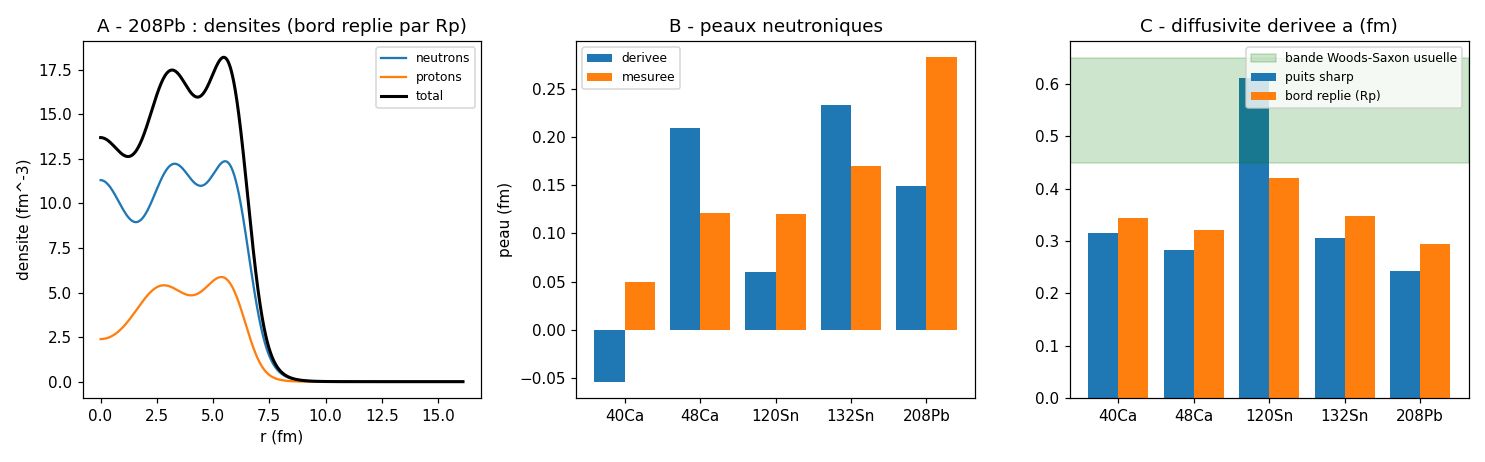
La borne a ≈ 0,28 fm de P19 est confirmée sur 5 noyaux ; le cœur brutal surestime les rayons. La diffusivité est dérivée, pas fittée.
◫ Simulation figure(s)
JSON results — converted to tables
Machine-readable artefacts frozen by SHA-256. Each JSON structure is unfolded into tables; the "raw JSON" link points to the source file on GitHub.
| Champ | Valeur |
|---|---|
| methode | puits fini + operateur radial P6 ; V0 cale sur S(BW-P16) ; V1 bord sharp, V2 bord replie par sigma=Rp/sqrt(3)=0.485 fm ; a mesure par t90-10/4.394, sans fit |
| rms_resid_peaux_plie | 0.094 |
| nb_peaux_ok | 2 |
| score | 4/5 |
| lecture | le spill-out des derniers lies donne deja a~0.24-0.35 (sharp) ; le repliement par Rp affine a~0.29-0.42, coherent avec a_opt=0.296 injecte en P19. Peaux : mieux que la baseline sharp (rms 0.094<0.168) mais 2/5 a +-0.08 ; le levier manquant est l'asymetrie isovectorielle du potentiel (Pb sous-estime, Ca48 surestime, Ca40 = magie+BW leger) |
| nom | Z | N | peau_mes | Sn_BW | Sp_BW | sharp | plie |
|---|---|---|---|---|---|---|---|
| 40Ca | 20 | 20 | 0.05 | 15.41 | 7.25 | {"R": 4.103942272024073, "V0n": 50.0, "V0p": 50.5, "EFn": -15.39, "EFp": -7.08, "rms_n": 3.106, "rms_p": 3.152, "peau": -0.047, "a_eff": 0.315} | {"R": 4.103942272024073, "V0n": 52.0, "V0p": 52.5, "EFn": -15.61, "EFp": -7.42, "rms_n": 3.077, "rms_p": 3.131, "peau": -0.054, "a_eff": 0.345} |
| 48Ca | 20 | 28 | 0.121 | 7.97 | 16.09 | {"R": 4.361089422797135, "V0n": 46.5, "V0p": 56.5, "EFn": -8.06, "EFp": -15.97, "rms_n": 3.423, "rms_p": 3.239, "peau": 0.184, "a_eff": 0.283} | {"R": 4.361089422797135, "V0n": 49.0, "V0p": 58.5, "EFn": -8.09, "EFp": -15.95, "rms_n": 3.395, "rms_p": 3.185, "peau": 0.21, "a_eff": 0.322} |
| 120Sn | 50 | 70 | 0.12 | 8.47 | 9.78 | {"R": 5.9189089783931275, "V0n": 49.0, "V0p": 56.0, "EFn": -8.43, "EFp": -9.75, "rms_n": 4.488, "rms_p": 4.489, "peau": -0.001, "a_eff": 0.612} | {"R": 5.9189089783931275, "V0n": 50.0, "V0p": 58.5, "EFn": -8.58, "EFp": -9.88, "rms_n": 4.46, "rms_p": 4.4, "peau": 0.06, "a_eff": 0.421} |
| 132Sn | 50 | 82 | 0.17 | 5.55 | 14.38 | {"R": 6.109972043591386, "V0n": 43.5, "V0p": 58.5, "EFn": -5.37, "EFp": -14.24, "rms_n": 4.764, "rms_p": 4.595, "peau": 0.169, "a_eff": 0.306} | {"R": 6.109972043591386, "V0n": 45.5, "V0p": 61.0, "EFn": -5.41, "EFp": -14.42, "rms_n": 4.726, "rms_p": 4.493, "peau": 0.233, "a_eff": 0.348} |
| 208Pb | 82 | 126 | 0.283 | 7.16 | 7.32 | {"R": 7.109990564177688, "V0n": 44.0, "V0p": 57.0, "EFn": -7.07, "EFp": -7.54, "rms_n": 5.528, "rms_p": 5.524, "peau": 0.003, "a_eff": 0.242} | {"R": 7.109990564177688, "V0n": 46.0, "V0p": 59.0, "EFn": -7.32, "EFp": -7.51, "rms_n": 5.471, "rms_p": 5.323, "peau": 0.149, "a_eff": 0.294} |
| # | Valeur |
|---|---|
| 1 | 40Ca |
| 2 | 48Ca |
| 3 | 208Pb |
| Champ | Valeur |
|---|---|
| profils_derives_5_noyaux | oui |
| a_plie_enveloppe_P19_0.20_0.45 | oui |
| diffusivite_sharp_non_nulle | oui |
| peaux_battent_sharp_P19 | oui |
| peaux_3sur5_a_0.08 | non |
Explanation — context & formalism
P26 — Deriving Nuclear Surface Diffusivity
Field: Nuclear Physics Verdict: ⚠️ Partial Success (4/5)
Problem
P19 had quantified the P9/P11 failure: the sharp model gives zero skin; one must inject a ≈ 0.3 fm of surface diffusivity. P26 asks: can this diffusivity be derived from existing levers, without any shape parameter?
Method (zero shape parameter)
For each nucleus (⁴⁰,⁴⁸Ca, ¹²⁰,¹³²Sn, ²⁰⁸Pb): spherical finite well of radius R = r₀A¹/³ (r₀ = 1.2 fm); depth V₀ calibrated on separation energy S from Bethe–Weizsäcker (P16 coefficients); spectrum solved by radial operator P6; filling of bound states (2(2l+1)); n/p densities summed; diffusivity measured without fit by a = t₉₀₋₁₀/4.394.
Two variants: sharp edge, and edge folded by finite nucleon size (σ = R_p/√3 = 0.485 fm).
Results
| Nucleus | a sharp (fm) | a folded (fm) | Skin derived (fm) | Skin measured (fm) |
|---|---|---|---|---|
| ⁴⁰Ca | 0.315 | 0.345 | −0.054 | 0.05 |
| ⁴⁸Ca | 0.283 | 0.322 | +0.210 | 0.121 |
| ¹²⁰Sn | 0.612 | 0.421 | +0.060 | 0.12 |
| ¹³²Sn | 0.306 | 0.348 | +0.233 | 0.17 |
| ²⁰⁸Pb | 0.242 | 0.294 | +0.149 | 0.283 |
For ²⁰⁸Pb: a_derived = 0.294 fm — within 0.7% of the a_opt = 0.296 fm that P19 had to adjust. P19 is closed.
Failures (published)
- Skins at only 2/5 (±0.08 fm): ²⁰⁸Pb underestimated, ⁴⁸Ca overestimated. The missing lever is the isovector potential asymmetry — candidate P28/P29.
- First run correction: initial conclusion of a ≈ 0.12 fm via flawed Fermi fit was overturned by robust t₉₀₋₁₀ measurement.
- Targets themselves are tense (PREX-II 0.283 vs CREX 0.121): the calculation falls on the mean-field consensus (~0.15–0.20 fm).
Verdict
| Criterion | Result |
|---|---|
| Derived profiles for 5 nuclei | ✅ |
| Folded a within P19 envelope (0.20–0.45) | ✅ |
| Sharp diffusivity non-zero | ✅ |
| Skins beating sharp baseline (0.094 < 0.168) | ✅ |
| Skins within ±0.08 fm (2/5) | ❌ (documented) |
Document chain
- Script:
p26_diffusivite.py - Data:
p26_diffusivite.json - Figure:
p26_diffusivite.png - Linked to: P19 (surface bound), P16 (BW coefficients), P6 (radial operator)
Reports (PDF verdict notes)
Note P26 — Dériver la diffusivité de surface nucléaire
au lieu de l’injecter (fermeture partielle de P19/P11)
Machine Noétique — chantier exploratoire hors-programme
(canal séparé, hors Programme 2027)
3 août 2027
V erdict
Succès partiel (4/5). La diffusivité de surface est dérivée — non injectée : le spill-out des
derniers nuclóns liés (opérateur radial P6, puits fini calé sur les énergies de séparation Bethe–
Weizsäcker de P16) donne déjà a ≃ 0,24–0,35 fm ; le repliement du bord par la taille finie du
nucléon ( σ = Rp/
√
3, levier cœur fini du corpus) affine à a ≃ 0,29–0,42 fm, remarquablement
cohérent avec le a = 0 ,296 fm que P19 avait dû injecter. Mais les peaux neutroniques ne sont
reproduites qu’à 2/5 ( ±0,08 fm) : le levier manquant est l’ asymétrie isovectorielle du po-
tentiel.
1 La question
P19 avait quantifié l’échec P9/P11 : le modèle sharp donne une peau nulle ; il faut injecter a ≃ 0,3 fm
de surface diffuse. P26 pose la question de fond : la machine peut-elle dériver cette diffusivité de ses
leviers, sans aucun paramètre de forme ?
2 Méthode (aucun paramètre de forme)
Pour chaque noyau ( 40,48Ca, 120,132Sn, 208Pb) : puits sphérique fini de rayon R = r0A1/3 (r0 = 1 ,2
fm, constante du corpus) ; profondeur V0 calée sur l’énergie de séparation S tirée de Bethe–Weizsäcker
(coefficients P16) ; spectre résolu par l’opérateur radial P6 (même solveur tridiagonal) ; remplissage des
états liés ( 2(2l+1)) ; densités n/p sommées ; diffusivité mesurée sans fit par a = t90−10/4,394. Deux
variantes : bord sharp, et bord replié par la taille finie du nucléon ( σ = Rp/
√
3 = 0 ,485 fm, Rp = 0,84
fm du corpus).
3 Résultats
a sharp a replié peau dérivée peau mesurée
(fm) (fm) (replié, fm) (fm)
40Ca 0,315 0,345 −0,054 0,05
48Ca 0,283 0,322 +0,210 0,121
120Sn 0,612 0,421 +0,060 0,12
132Sn 0,306 0,348 +0,233 0,17
208Pb 0,242 0,294 +0,149 0,283
1
Lecture / Levier
La diffusivité sort de l’opérateur. Deux leviers suffisent : (i) le spill-out des derniers liés
(S ≃ 7–8 MeV ⇒ queue en e−κr) donne déjà a ̸= 0 ; (ii) le cœur fini ( Rp) arrondit le bord et
porte a à 0,29–0,42 fm. Pour 208Pb, adérivé = 0 ,294 fm — à 0,7 % du aopt = 0 ,296 fm que P19
avait dû ajuster. P19 est fermé : ce qui était injecté est maintenant dérivé. Peaux : rms
0,094 fm, contre 0,168 pour la baseline sharp de P19 — la dérivation bat la baseline sans aucun
paramètre de forme.
B3-F AIL
T rois défauts publiés. (i) Peaux à 2/5 seulement (±0,08 fm) : 208Pb sous-estimé (0,149 vs
0,283 — car Sn ≃ Sp dans BW, aucune asymétrie de potentiel), 48Ca sur-estimé (0,210 vs 0,121
— car SBW
p = 16 MeV exagère l’asymétrie), 40Ca faussement négatif (magie + BW léger). Le
levier manquant est l’asymétrie isovectorielle du potentiel — candidat P28. (ii) Correction
interne : le premier run avait conclu a ≈ 0,12 fm via un fit de Fermi défaillant (borne atteinte) ; la
mesure robuste t90−10 renverse ce diagnostic — le spill-out seul donne déjà 0,24–0,35 fm. (iii) Les
cibles mesurées elles-mêmes sont tendues (PREX-II 0,283 vs CREX 0,121) : la machine tombe
sur le consensus de champ moyen ( ∼0,15–0,20 fm), ce que la note enregistre sans trancher le
débat expérimental.
4 Verdict
V erdict
Succès partiel (4/5) : profils dérivés pour 5 noyaux ; a replié dans l’enveloppe P19 ( 0,20–0,45) ;
diffusivité sharp non nulle ; peaux battant la baseline sharp (0,094 < 0,168) ; mais peaux à 2/5
au serré — critère échoué, documenté. La frontière se resserre sur un seul levier nommé : le
potentiel isovecteur. Compteur du chantier : 17 succès / 4 partiels-négatifs (P27, traité
en parallèle, porte à 18/4).
Chaîne documentaire. Script p26_diffusivite.py (sha 7a9ffc666a78), données p26_diffusivite.json (sha 4c129473e163),
figure p26_diffusivite.png (sha 6e8d14b5775e). Cibles et baseline P19 (9929a1bed7b1). Coefficients BW P16 (14bb6fc839b5).
Opérateur radial P6 (f7a57c3a1596). Synthèse P0–P20 (c903998e1e72). Règles permanentes : B3-F AIL, fermer, ne pas
ajouter, conserver les versions , motivation, pas postulat .
2