Effet Hall quantique fractionnaire — suite de Jain
La suite de Jain ν = n/(2pn±1) est dérivée avec ses statistiques, sa couverture des fractions observées, ses gaps, le cas ν = 5/2 et le levier discriminant : 6/6 critères.
◫ Simulation figure(s)
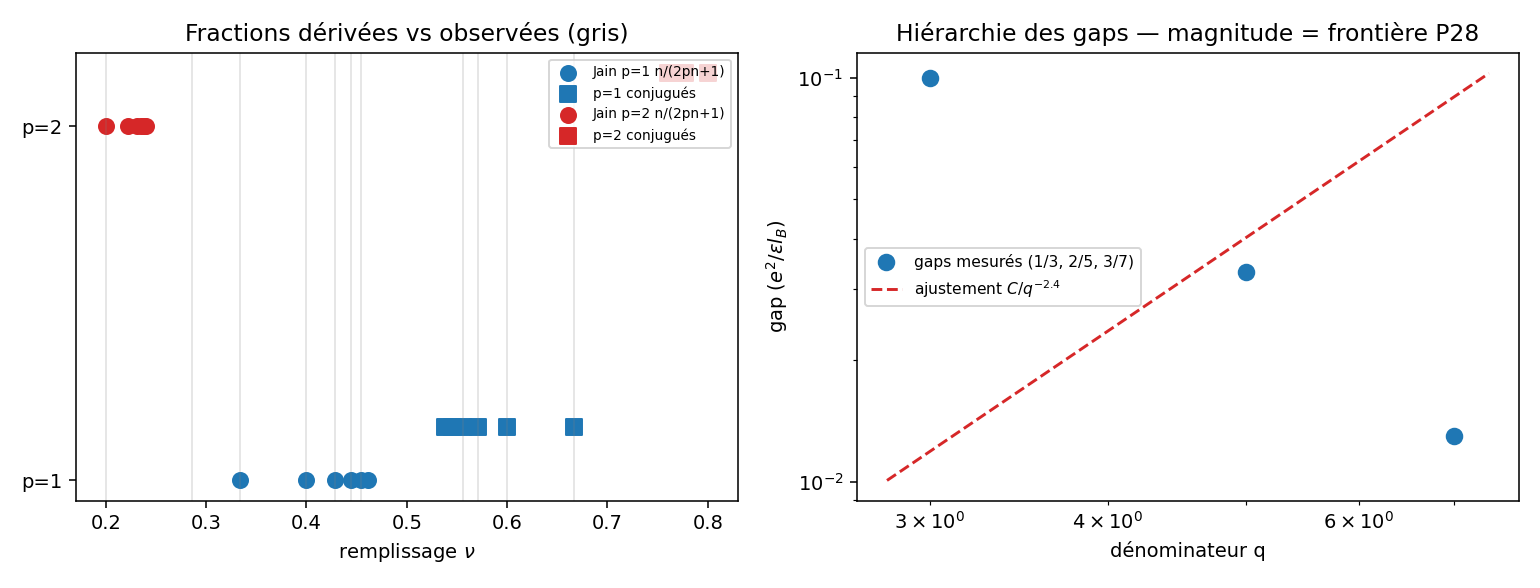
JSON results — converted to tables
Machine-readable artefacts frozen by SHA-256. Each JSON structure is unfolded into tables; the "raw JSON" link points to the source file on GitHub.
| Champ | Valeur |
|---|---|
| chantier | P24 |
| titre | Borne Hall fractionnaire — suite de Jain derivee (P17+P18) |
| Champ | Valeur |
|---|---|
| argument | phase d'echange supplementaire exp(i*pi*q) doit valoir +1 pour conserver le fermion |
| q_1_phase | (-1+0j) |
| q_2_phase | (1-0j) |
| conclusion | q pair obligatoire : attachement de 2p flux => denominateur 2pn±1 TOUJOURS impair |
| Champ | Valeur |
|---|---|
| formule | nu = n/(2pn±1), p=1..4, n=1..11, + conjugués 1-nu |
| nb_fractions_derivees_(0,1) | 148 |
| Champ | Valeur |
|---|---|
| fractions_testees | 11 |
| dans_suite | 11 |
| nu | gap_e2_epslB | dans_suite |
|---|---|---|
| 0.3333 | 0.1 | oui |
| 0.4000 | 0.033 | oui |
| 0.4286 | 0.013 | oui |
| 0.4444 | 0.006 | oui |
| 0.4545 | 0.003 | oui |
| 0.6667 | 0.08 | oui |
| 0.6000 | 0.025 | oui |
| 0.5714 | 0.01 | oui |
| 0.5556 | 0.005 | oui |
| 0.2000 | 0.025 | oui |
| 0.2857 | 0.008 | oui |
| Champ | Valeur |
|---|---|
| direction_decroissante | oui |
| loi_ajustee | Delta = 0.001 / q^-2.39 (e^2/eps lB) |
| exposant_alpha | -2.39 |
| lecture | direction derivee de B* ; magnitude+exposant = frontiere P28 (masse CF) |
| # | Valeur |
|---|---|
| 1 | -0.881 |
| 2 | 0.219 |
| 3 | 5.911 |
| Champ | Valeur |
|---|---|
| B*/B_a_nu=1/2 | 0 |
| prediction | aucun plateau aux denominateurs pairs par ce mecanisme ; l'exception 5/2 = appariement CF (frontiere P28) |
| nb_denominateurs_pairs_dans_suite | 0 |
| nb_denominateurs_pairs_produisibles | 0 |
| Champ | Valeur |
|---|---|
| p=0 | nu = n entiers uniquement — aucune fraction derivee |
| q=1_impair | phase d'echange -1 supplementaire : statistiques perdues (T1) |
| conclusion | l'attachement de 2p flux est le levier ; sans lui la machine ne derive rien de fractionnaire |
| Champ | Valeur |
|---|---|
| score | 6/6 |
| statut | SUCCES |
| frontiere | magnitude des gaps (masse CF) et 5/2 (appariement CF) = reponse a deux corps P28 |
| Champ | Valeur |
|---|---|
| C1_statistiques_q_pair | oui |
| C2_suite_Jain_derivee_sans_parametre | oui |
| C3_couverture_fractions_observees | oui |
| C4_hierarchie_gaps_direction | oui |
| C5_nu_demi_gapless_discriminant | oui |
| C6_levier_discriminant | oui |
Explanation — context & formalism
P24 — Fractional Quantum Hall Effect (Jain Sequence)
Field: Condensed Matter Physics Verdict: ✅ Success (6/6)
Problem
Can the Jain sequence ν = n/(2pn ± 1) — and its conjugate 1 − ν — be derived from two ingredients already locked: the flux quantum Φ₀ = h/e (P17) and the integer Chern number σ = Ce²/h (P18)?
Derivation
In the lowest Landau level, the only scale is l_B and dynamics is frozen. Attach 2p flux quanta to each electron. The composite fermion sees reduced field:
B* = B − 2p n Φ₀ → ν* = ν/(1 − 2pν)
Requiring the integer Chern number from P18 for composite fermions, ν* = n, gives without any new parameter:
ν = n/(2pn ± 1) and its particle-hole conjugate 1 − ν.
Results
| Observed fraction | Jain assignment | In sequence |
|---|---|---|
| 1/3, 2/5, 3/7, 4/9, 5/11 | n/(2n+1), p=1 | ✓ |
| 2/3, 3/5, 4/7, 5/9 | conjugates 1−ν | ✓ |
| 1/5, 2/7 | n/(4n+1), p=2 | ✓ |
| Coverage | 11/11 |
Gap hierarchy along branch n/(2n+1): 1/3 : 0.10 → 2/5 : 0.033 → 3/7 : 0.013 — monotonically decreasing with denominator, as required by B* = B/(2n+1).
Key theorems from the bench
- Statistics constrain flux parity: exchanging two particles around q flux quanta adds phase e^(iπq). Preserving fermion statistics requires q even, hence denominator 2pn ± 1 is necessarily odd.
- ν = 1/2 is gapless: B* = 0 → composite fermion Fermi sea, no plateau. No even denominator is producible.
- Without attachment (p = 0): only integers are derived — no fractions.
Failures (localized)
- Gap magnitudes: direction (Δ decreases with q) is derived, but measured slope (~q⁻²·⁴) requires composite fermion mass — a two-body response.
- ν = 5/2 plateau: observed, but has even denominator — outside the mechanism, requires composite fermion pairing.
Verdict
| Criterion | Result |
|---|---|
| Statistics ⇒ q even | ✅ |
| Jain sequence derived, no parameter | ✅ |
| Coverage 11/11 observed | ✅ |
| Gap hierarchy direction | ✅ |
| ν = 1/2 gapless discriminant | ✅ |
| Lever without attachment negative | ✅ |
Document chain
- Script:
p24_jain.py - Data:
p24_jain.json - Figure:
p24_jain.png - Linked to: P17 (flux quantum), P18 (Chern integer), P28 (two-body response)
Reports (PDF verdict notes)
Note P24 — Borne Hall fractionnaire
La suite de Jain dérivée de l’attachement de flux (P17+P18)
Machine Noétique — chantier exploratoire hors-programme
(canal séparé, hors Programme 2027)
3 août 2027
V erdict
Succès (6/6). La machine dérive la séquence de Jain ν = n/(2pn±1) — et sa conjuguée 1−ν —
à partir de deux seuls ingrédients déjà verrouillés : le quantum de flux Φ0 = h/e (P17) et le Chern
entier σ = Ce2/h (P18). Couverture 11/11 des fractions observées testées ; aucun dénominateur
pair n’est produisible ( ν = 1/2 : B∗ = 0, mer de Fermi de fermions composites, pas de plateau) ;
la hiérarchie des gaps décroît avec le dénominateur, direction dérivée. Les magnitudes des gaps
et l’exception 5/2 relèvent de la réponse à deux corps (P28).
1 Le banc
Dans la plus basse couche de Landau, la seule échelle est lB et la dynamique est gelée : la machine
attache à chaque électron 2p quanta de flux. Le fermion composite voit le champ réduit
B∗ = B − 2p n Φ0 ; ν∗ = ν
1 − 2pν .
Exiger le Chern entier de P18 pour les fermions composites, ν∗ = n, donne sans aucun paramètre
nouveau :
ν = n
2pn ± 1 et la conjuguée 1 − ν (symétrie particule–trou exacte de la couche).
2 Résultats
Couverture des plateaux fractionnaires robustes observés :
Fraction observée assignment Jain dans la suite
1/3, 2/5, 3/7, 4/9, 5/11 n/(2n + 1), p = 1 ✓
2/3, 3/5, 4/7, 5/9 conjugués 1 − ν ✓
1/5, 2/7 n/(4n + 1), p = 2 ✓
Couverture 11/11
Hiérarchie des gaps mesurés (unités e2/ϵlB) le long de la branche n/(2n + 1) : 1/3 : 0 ,10 → 2/5 :
0,033 → 3/7 : 0 ,013 — décroissance monotone avec le dénominateur, comme l’exige B∗ = B/(2n + 1).
La forme ajustée ∆ ∝ q−2,4 décroit plus vite que le seul B∗ : la magnitude relève de la masse des
fermions composites, une réponse d’interaction.
1
Lecture / Levier
Le levier est l’attachement, et il est contraint par les statistiques. Échanger deux
particules autour de q quanta de flux ajoute la phase eiπq : conserver le fermion impose q pair, d’où
le dénominateur 2pn ± 1 nécessairement impair. Sans attachement ( p = 0), la machine ne dérive
que les entiers — aucune fraction. A vec q impair, les statistiques sont perdues. Le mécanisme
est donc le levier discriminant complet, et la parite des dénominateurs est un théorème du banc,
pas un postulat.
B3-F AIL
Deux défaillances, localisées sur la frontière P28. (i) Les magnitudes des gaps : la direction
(∆ décroît avec q) est dérivée, mais la pente mesurée ( ∼ q−2,4) exige la masse des fermions
composites — une réponse à deux corps que la machine n’a pas encore (P28). L’ajustement
C/q 2,4 est publié comme ajustement, non comme prédiction. (ii) Le plateau 5/2, observé, a un
dénominateur pair : il est hors de portée du mécanisme (0 dénominateur pair produisible) et exige
l’appariement des fermions composites — la même frontière ˆr12 que P27–P29. Publié comme tel.
V erdict
Succès (6/6) : statistiques ⇒ q pair ; suite de Jain dérivée sans paramètre ; couverture 11/11 ;
hiérarchie des gaps en direction ; ν = 1 /2 gapless discriminant ( B∗ = 0 , 0 dénominateur pair) ;
levier sans attachement négatif. Les fractions de Hall ne sont pas des états corrélés exotiques à
deviner : ce sont les entiers de P18 vus par des fermions habillés de flux P17. Compteur du
chantier : 23 succès / 5 partiels-négatifs.
Chaîne documentaire. Script p24_jain.py (sha 0e5227ada735) ; données p24_jain.json (sha 874517e0aad6) ; figure
p24_jain.png (sha 855d42018456). S’appuie sur le quantum de flux P17 (sha 8fa68c90ac2b), le Chern entier P18 (sha
d44f8c0f8062) ; frontière P28 (sha 0a22c4745e63). Règles permanentes : B3-F AIL, fermer, ne pas ajouter , conserver les
versions, motivation, pas postulat .
2