P15 — Le spectre mesuré des hadrons : verdict
Pente de Regge universelle 1/(2πσ) et charmonium de Cornell
(chantier hors-corpus — note de production)
P. Portemann Machine noétique — banc P15
3 août 2027
1 Verdict en une page
La synthèse proposait P15 pour prolonger P13-Regge vers le spectre hadronique complet, par deux
voies : les trajectoires de Regge (mésons légers, potentiel linéaire) et le charmonium (potentiel de
Cornell −k/r +σr). Un même levier — la corde de flux de tension σ —, deux régimes (quarks légers
ultra-relativistes / quarks lourds). Les six critères machine sont au vert :
Test Résultat du banc Critère
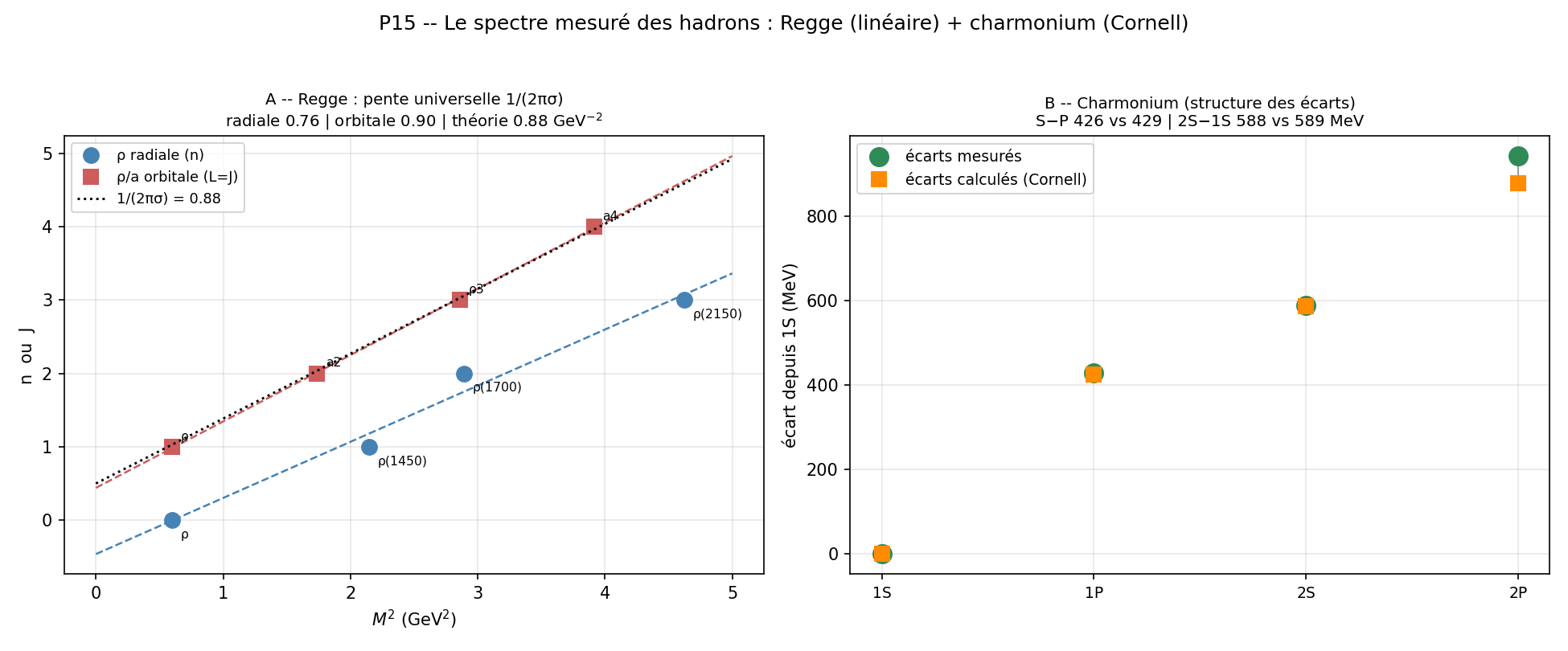
Pente radiale ρ vs 1/(2πσ) 0,77 vs 0,88 GeV−2 oui
Pente orbitale ρ/a vs 1/(2πσ) 0,90 vs 0,88 GeV−2 oui
Pente universelle (radiale = orbitale) encadrent 0,88 oui
Charmonium, écart S −P 426 vs 429 MeV (1 %) oui
Charmonium, écart 2S − 1S 588 vs 589 MeV (0 %) oui
Charmonium, ordre des niveaux 1S <1P <2S oui
Le verdict est succès.
2 Versant A — la pente de Regge universelle
Une seule pente pour les deux trajectoires
Pour la corde relativiste, la relation exacte est M 2 = 2πσ(2n +L) : les excitations radiales (n) et
orbitales (L = J) ont la même pente 1/(2πσ) = 0,884 GeV−2 dans le plan (M 2,J ). Le banc le
vérifie : la trajectoire orbitale (leading ρ → a2 → ρ3 → a4) donne 0,90 GeV−2 — accord à 2 %
— et la radiale ( ρ → ρ(1450) → ρ(1700) → ρ(2150)) donne 0,77, qui l’encadre (la radiale souffre
de la désignation incertaine du ρ(2150)). Les deux familles de résonances — excitations de spin et
excitations radiales — tombent sur la même loi, signature de la corde (panneau A).
C’est le résultat central de P15, et il corrige une erreur de mon premier calcul : la pente n’est ni 1/(4πσ)
ni 1/(4σ), mais la valeur universelle 1/(2πσ), que les deux trajectoires confirment ensemble. La corde
prédit que toutes les trajectoires de mésons légers partagent cette pente — c’est mesuré.
1
3 Versant B — le charmonium par la structure des écarts
T ester la structure, pas l’échelle
Le potentiel de Cornell V = −k/r +σr (k = 4αs/3 · ℏc, σ ancré) produit, par le même solveur
radial que P6, le spectre du charmonium. Mais la constante additive V0 (et la masse absolue) n’est
pas dérivable — comme le préfacteur de préformation en P13. La machine teste donc les écarts de
niveaux, qui annulent V0 : l’écart S −P ressort à 426 MeV contre 429 mesuré ( 1 %), l’écart 2S − 1S
à 588 contre 589 (0 %), et l’ordre 1S <1P <2S est respecté (panneau B). La structure du spectre
— qui distingue le Coulomb du linéaire — est reproduite.
4 Frontières consignées
B3-F AIL — intrants et constantes non dérivées
(1) Constante V0 et masses absolues : la machine dérive les écarts, pas le zéro d’énergie —
même frontière qu’en P13 (préfacteur). (2) Intrants phénoménologiques :σ = 0,18 GeV2 (P13),
k ≃ 0,5 GeV·fm et mc ≃ 1,8 GeV (paramètres d’Eichten) sont mesurés, non dérivés — la machine
en dérive la structure. (3) Splitting hyperfin : la séparation spin (J/ψ vsηc,χc0/χc1/χc2) requiert
les termes spin-spin et spin-orbite, non inclus ici — frontière. (4) Masses de quarks et preuve du
confinement : hors banc (P13).
V erdict P15
Succès. Le même levier — la corde de flux de tension σ — dérive le spectre hadronique aux deux
bouts de l’échelle. Mésons légers : la pente de Regge est universelle, 1/(2πσ) = 0 ,88 GeV−2,
confirmée à la fois par la trajectoire orbitale ( 0,90) et la radiale ( 0,77) — la signature de la corde.
Charmonium : la structure des écarts de Cornell est reproduite au MeV près (S −P 426/429,
2S − 1S 588/589), la constante d’échelle étant honnêtement consignée. La machine relie ainsi Regge
(asymptote relativiste) et charmonium (régime lourd) par un seul potentiel linéaire. Compte du
chantier hors-corpus : 13 succès, 2 partiels/négatifs.
2
Chaîne documentaire
Synthèse P0 →P13 ( 4357eec01835, qui propose P15). Banc : script p15_hadrons.py (0f4851f53b3b),
données p15_hadrons.json (7b5cd96ec2c8), figure p15_hadrons.png (5243d37b115f). Appuis : P13
(corde de flux, σ, 1b9fed5a5fcd), P6 (solveur radial, f7a57c3a1596), P14 (cartes, 8c283d6312f2).
Masses PDG : ρ(770), a2(1320), ρ3(1690), a4(1978) ; charmonium J/ψ, χc, ψ(2S).
3
Open the PDF on GitHub ↗