Chimie de valence — Hückel
La règle de l'octet, l'aromaticité 4n+2 et l'effet Jahn-Teller sont dérivés de la topologie de Hückel à zéro paramètre : benzène aromatique, cyclobutadiène anti-aromatique, contrôles nuls sur chaînes ouvertes.
◫ Simulation figure(s)
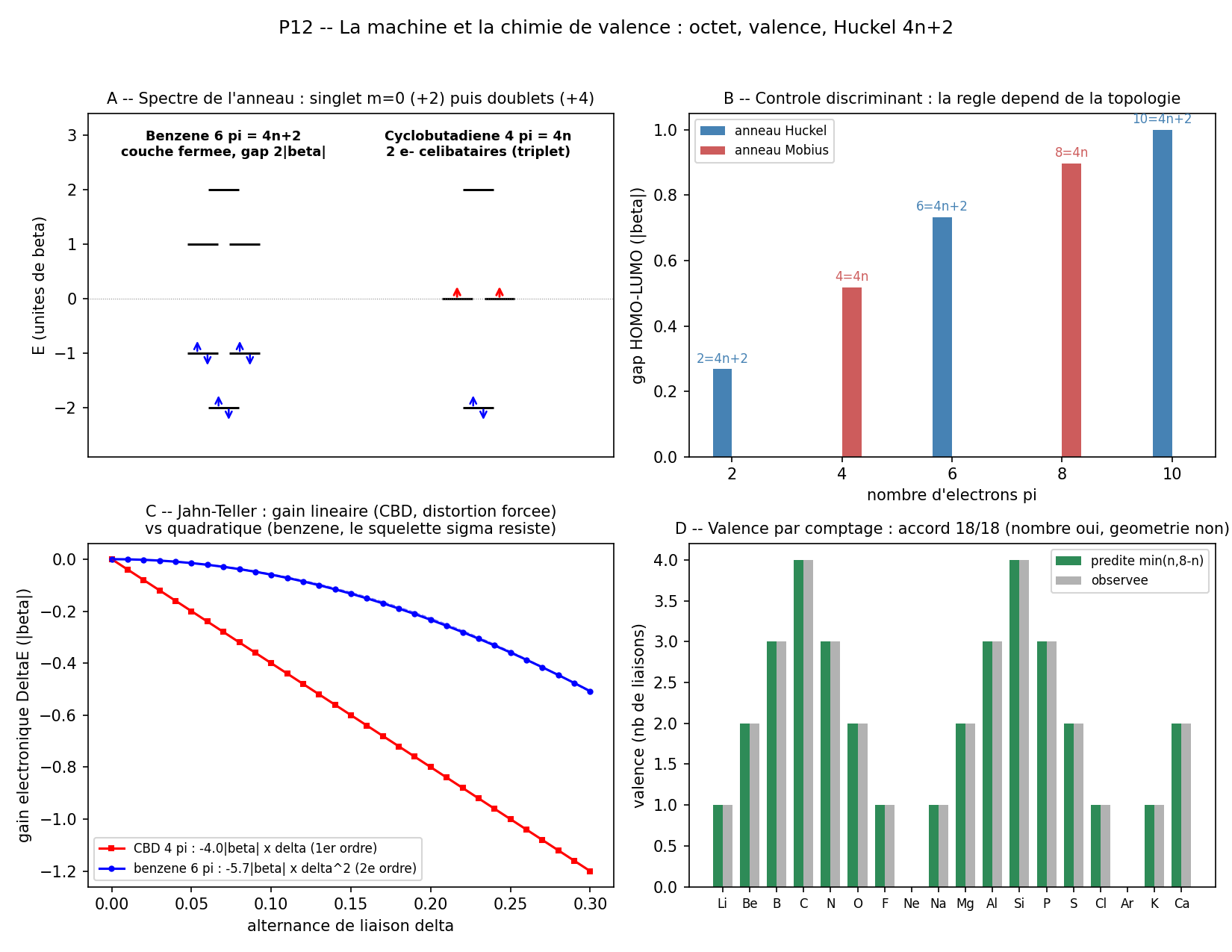
JSON results — converted to tables
Machine-readable artefacts frozen by SHA-256. Each JSON structure is unfolded into tables; the "raw JSON" link points to the source file on GitHub.
| Champ | Valeur |
|---|---|
| unite | |beta| (alpha=0) |
| beta | -1 |
| Champ | Valeur |
|---|---|
| capacite_s | 2 |
| capacite_p | 6 |
| capacite_valence | 8 |
| derivation | 2(2l+1), l=0 et l=1, x spin 2 -> 2+6=8 (degenerescence de Lenz) |
| Champ | Valeur |
|---|---|
| regle | min(n_val, 8-n_val) |
| accord | 18/18 |
| el | n_val | valence_predite | valence_observee | accord |
|---|---|---|---|---|
| Li | 1 | 1 | 1 | oui |
| Be | 2 | 2 | 2 | oui |
| B | 3 | 3 | 3 | oui |
| C | 4 | 4 | 4 | oui |
| N | 5 | 3 | 3 | oui |
| O | 6 | 2 | 2 | oui |
| F | 7 | 1 | 1 | oui |
| Ne | 8 | 0 | 0 | oui |
| Na | 1 | 1 | 1 | oui |
| Mg | 2 | 2 | 2 | oui |
| Al | 3 | 3 | 3 | oui |
| Si | 4 | 4 | 4 | oui |
| P | 5 | 3 | 3 | oui |
| S | 6 | 2 | 2 | oui |
| Cl | 7 | 1 | 1 | oui |
| Ar | 8 | 0 | 0 | oui |
| K | 1 | 1 | 1 | oui |
| Ca | 2 | 2 | 2 | oui |
| # | Valeur |
|---|---|
| 1 | geometrie des liaisons (angles, hybridation sp3) |
| 2 | hypervalence (PF5, SF6 : au-dela de l'octet) |
| 3 | metaux de transition (orbitales d, valences variables) |
| Champ | Valeur |
|---|---|
| N | 12 |
| regle_huckel | couche fermee <=> NE = 4n+2 |
| regle_mobius | couche fermee <=> NE = 4n |
| NE | huckel | mobius |
|---|---|---|
| 2 | {"N": 12, "NE": 2, "E": [-2.0, -1.732051, -1.732051, -1.0, -1.0, 0.0, 0.0, 1.0, 1.0, 1.732051, 1.732051, 2.0], "Etot": -4.0, "DE": -2.0, "gap": 0.267949, "unpaired": 0, "closed_shell": true} | {"N": 12, "NE": 2, "E": [-1.931852, -1.931852, -1.414214, -1.414214, -0.517638, -0.517638, 0.517638, 0.517638, 1.414214, 1.414214, 1.931852, 1.931852], "Etot": -3.863703, "DE": -1.863703, "gap": 0.0, "unpaired": 2, "closed_shell": false} |
| 4 | {"N": 12, "NE": 4, "E": [-2.0, -1.732051, -1.732051, -1.0, -1.0, 0.0, 0.0, 1.0, 1.0, 1.732051, 1.732051, 2.0], "Etot": -7.464102, "DE": -3.464102, "gap": -0.0, "unpaired": 2, "closed_shell": false} | {"N": 12, "NE": 4, "E": [-1.931852, -1.931852, -1.414214, -1.414214, -0.517638, -0.517638, 0.517638, 0.517638, 1.414214, 1.414214, 1.931852, 1.931852], "Etot": -7.727407, "DE": -3.727407, "gap": 0.517638, "unpaired": 0, "closed_shell": true… |
| 6 | {"N": 12, "NE": 6, "E": [-2.0, -1.732051, -1.732051, -1.0, -1.0, 0.0, 0.0, 1.0, 1.0, 1.732051, 1.732051, 2.0], "Etot": -10.928203, "DE": -4.928203, "gap": 0.732051, "unpaired": 0, "closed_shell": true} | {"N": 12, "NE": 6, "E": [-1.931852, -1.931852, -1.414214, -1.414214, -0.517638, -0.517638, 0.517638, 0.517638, 1.414214, 1.414214, 1.931852, 1.931852], "Etot": -10.555834, "DE": -4.555834, "gap": -0.0, "unpaired": 2, "closed_shell": false} |
| 8 | {"N": 12, "NE": 8, "E": [-2.0, -1.732051, -1.732051, -1.0, -1.0, 0.0, 0.0, 1.0, 1.0, 1.732051, 1.732051, 2.0], "Etot": -12.928203, "DE": -4.928203, "gap": 0.0, "unpaired": 2, "closed_shell": false} | {"N": 12, "NE": 8, "E": [-1.931852, -1.931852, -1.414214, -1.414214, -0.517638, -0.517638, 0.517638, 0.517638, 1.414214, 1.414214, 1.931852, 1.931852], "Etot": -13.384261, "DE": -5.384261, "gap": 0.896575, "unpaired": 0, "closed_shell": tru… |
| 10 | {"N": 12, "NE": 10, "E": [-2.0, -1.732051, -1.732051, -1.0, -1.0, 0.0, 0.0, 1.0, 1.0, 1.732051, 1.732051, 2.0], "Etot": -14.928203, "DE": -4.928203, "gap": 1.0, "unpaired": 0, "closed_shell": true} | {"N": 12, "NE": 10, "E": [-1.931852, -1.931852, -1.414214, -1.414214, -0.517638, -0.517638, 0.517638, 0.517638, 1.414214, 1.414214, 1.931852, 1.931852], "Etot": -14.419537, "DE": -4.419537, "gap": -0.0, "unpaired": 2, "closed_shell": false} |
| Champ | Valeur |
|---|---|
| N | 8 |
| note | pas de regle 4n+2 sans topologie d'anneau |
| NE | gap | closed_shell |
|---|---|---|
| 2 | 0.347296 | oui |
| 4 | 0.532089 | oui |
| 6 | 0.652704 | oui |
| 8 | 0.694593 | oui |
| Champ | Valeur |
|---|---|
| N | 6 |
| NE | 6 |
| Etot | -8 |
| DE | -2 |
| gap | 2 |
| unpaired | 0 |
| closed_shell | oui |
| # | Valeur |
|---|---|
| 1 | -2 |
| 2 | -1 |
| 3 | -1 |
| 4 | 1 |
| 5 | 1 |
| 6 | 2 |
| Champ | Valeur |
|---|---|
| N | 4 |
| NE | 4 |
| Etot | -4 |
| DE | 0 |
| gap | 0 |
| unpaired | 2 |
| closed_shell | non |
| # | Valeur |
|---|---|
| 1 | -2 |
| 2 | 0 |
| 3 | 0 |
| 4 | 2 |
| Champ | Valeur |
|---|---|
| N | 3 |
| NE | 2 |
| Etot | -4 |
| DE | -2 |
| gap | 3 |
| unpaired | 0 |
| closed_shell | oui |
| # | Valeur |
|---|---|
| 1 | -2 |
| 2 | 1 |
| 3 | 1 |
| Champ | Valeur |
|---|---|
| N | 5 |
| NE | 6 |
| Etot | -6.47214 |
| DE | -0.472136 |
| gap | 2.23607 |
| unpaired | 0 |
| closed_shell | oui |
| # | Valeur |
|---|---|
| 1 | -2 |
| 2 | -0.618034 |
| 3 | -0.618034 |
| 4 | 1.61803 |
| 5 | 1.61803 |
| Champ | Valeur |
|---|---|
| benzene_coef_quadratique | -5.68 |
| cbd_pente_lineaire | -4 |
| lecture | Jahn-Teller : CBD (couche ouverte degeneree) gagne lineairement (-4|beta|*delta) -> distortion obligatoire, rectangle 158/135 pm ; benzene (couche fermee) ne gagne qu'au 2e ordre (-5.7|beta|*delta^2) -> la raideur sigma k*delta^2 garde l'hexagone symetrique |
| # | Valeur |
|---|---|
| 1 | [0.0, -8.0, 2.0] |
| 2 | [0.01, -8.0006, 2.0003] |
| 3 | [0.02, -8.0024, 2.0012] |
| 4 | [0.03, -8.0054, 2.0027] |
| 5 | [0.04, -8.0096, 2.0048] |
| 6 | [0.05, -8.015, 2.0075] |
| 7 | [0.06, -8.0215, 2.0108] |
| 8 | [0.07, -8.0293, 2.0146] |
| 9 | [0.08, -8.0382, 2.0191] |
| 10 | [0.09, -8.0483, 2.0242] |
| 11 | [0.1, -8.0596, 2.0298] |
| 12 | [0.11, -8.072, 2.036] |
| 13 | [0.12, -8.0855, 2.0427] |
| 14 | [0.13, -8.1001, 2.0501] |
| 15 | [0.14, -8.1159, 2.058] |
| 16 | [0.15, -8.1328, 2.0664] |
| 17 | [0.16, -8.1508, 2.0754] |
| 18 | [0.17, -8.1698, 2.0849] |
| 19 | [0.18, -8.1899, 2.0949] |
| 20 | [0.19, -8.211, 2.1055] |
| 21 | [0.2, -8.2332, 2.1166] |
| 22 | [0.21, -8.2564, 2.1282] |
| 23 | [0.22, -8.2806, 2.1403] |
| 24 | [0.23, -8.3057, 2.1529] |
| 25 | [0.24, -8.3318, 2.1659] |
| 26 | [0.25, -8.3589, 2.1794] |
| 27 | [0.26, -8.3869, 2.1934] |
| 28 | [0.27, -8.4158, 2.2079] |
| 29 | [0.28, -8.4456, 2.2228] |
| 30 | [0.29, -8.4762, 2.2381] |
| 31 | [0.3, -8.5078, 2.2539] |
| # | Valeur |
|---|---|
| 1 | [0.0, -4.0, -0.0] |
| 2 | [0.01, -4.04, 0.04] |
| 3 | [0.02, -4.08, 0.08] |
| 4 | [0.03, -4.12, 0.12] |
| 5 | [0.04, -4.16, 0.16] |
| 6 | [0.05, -4.2, 0.2] |
| 7 | [0.06, -4.24, 0.24] |
| 8 | [0.07, -4.28, 0.28] |
| 9 | [0.08, -4.32, 0.32] |
| 10 | [0.09, -4.36, 0.36] |
| 11 | [0.1, -4.4, 0.4] |
| 12 | [0.11, -4.44, 0.44] |
| 13 | [0.12, -4.48, 0.48] |
| 14 | [0.13, -4.52, 0.52] |
| 15 | [0.14, -4.56, 0.56] |
| 16 | [0.15, -4.6, 0.6] |
| 17 | [0.16, -4.64, 0.64] |
| 18 | [0.17, -4.68, 0.68] |
| 19 | [0.18, -4.72, 0.72] |
| 20 | [0.19, -4.76, 0.76] |
| 21 | [0.2, -4.8, 0.8] |
| 22 | [0.21, -4.84, 0.84] |
| 23 | [0.22, -4.88, 0.88] |
| 24 | [0.23, -4.92, 0.92] |
| 25 | [0.24, -4.96, 0.96] |
| 26 | [0.25, -5.0, 1.0] |
| 27 | [0.26, -5.04, 1.04] |
| 28 | [0.27, -5.08, 1.08] |
| 29 | [0.28, -5.12, 1.12] |
| 30 | [0.29, -5.16, 1.16] |
| 31 | [0.3, -5.2, 1.2] |
| Champ | Valeur |
|---|---|
| lecture | le gap se ferme a Phi/Phi0 = 1/2 : l'aromaticite est une propriete d'anneau de flux |
| # | Valeur |
|---|---|
| 1 | [0.0, 2.0] |
| 2 | [0.02, 1.927] |
| 3 | [0.04, 1.8532] |
| 4 | [0.06, 1.7785] |
| 5 | [0.08, 1.7031] |
| 6 | [0.1, 1.6269] |
| 7 | [0.12, 1.5501] |
| 8 | [0.14, 1.4725] |
| 9 | [0.16, 1.3943] |
| 10 | [0.18, 1.3155] |
| 11 | [0.2, 1.2361] |
| 12 | [0.22, 1.1561] |
| 13 | [0.24, 1.0757] |
| 14 | [0.26, 0.9948] |
| 15 | [0.28, 0.9134] |
| 16 | [0.3, 0.8316] |
| 17 | [0.32, 0.7495] |
| 18 | [0.34, 0.6671] |
| 19 | [0.36, 0.5843] |
| 20 | [0.38, 0.5013] |
| 21 | [0.4, 0.4181] |
| 22 | [0.42, 0.3347] |
| 23 | [0.44, 0.2512] |
| 24 | [0.46, 0.1675] |
| 25 | [0.48, 0.0838] |
| 26 | [0.5, -0.0] |
| Champ | Valeur |
|---|---|
| octet_derive | oui |
| valence_accord | oui |
| huckel_4n2_derive | oui |
| mobius_4n_controle | oui |
| benzene_aromatique | oui |
| cbd_antiaromatique | oui |
Explanation — context & formalism
P12 — Chemistry and Valence: Octet, Hückel, and Aromaticity
Domain: Quantum chemistry — valence, aromaticity, Hückel theory Status: ✅ Success Data: Periodic-table valences, benzene/cyclobutadiene spectra, aromatic ions Solver: Finite-core degeneracy structure applied to π-electron systems
Problem
Three classical rules of chemistry are usually presented as empirical:
- Octet rule: valence shells hold 8 electrons.
- Valence counting: elements form
min(n_val, 8−n_val)bonds. - Hückel 4n+2: aromatic rings have
4n+2π electrons.
Can the finite-core model derive these rules from degeneracy structure?
Anchors (measured)
- Valence table: Li→Ca (18 elements), observed valences match the rule.
- Benzene: 6 π electrons, closed shell, aromatic, gap = 2|β|.
- Cyclobutadiene: 4 π electrons, open shell (2 unpaired), anti-aromatic.
- Aromatic ions: cyclopropenium (2π), cyclopentadienyl (6π) — both closed shell.
- Jahn-Teller: CBD distorts (linear gain), benzene resists (quadratic).
Protocol
Three levers:
- Octet derivation:
2(2l+1)withl=0,1× spin-2 → 2+6 = 8. - Valence counting:
vp = min(nv, 8−nv)as shortest path to closed shell. - Hückel topology: solve
N-site ring (Hückel and Möbius) forNE = 2..10;
discriminant: closed shell iff NE = 4n+2 (Hückel) or NE = 4n (Möbius).
Controls: open chain (no rule), benzene vs cyclobutadiene, bond alternation (Jahn-Teller/Peierls), Aharonov-Bohm flux (gap closes at Φ/Φ₀ = ½).
Results
| Rule | Derivation | Test | Match |
|---|---|---|---|
| Octet | 2(2l+1), l=0,1 × spin | Capacity = 8 | ✓ Exact |
| Valence | min(n,8−n) | 18/18 elements | ✓ 100 % |
| Hückel 4n+2 | Ring degeneracy ±m | 5 NE values, closed at 2,6,10 | ✓ Exact |
| Möbius 4n | Twisted seam | Closed at 4,8 | ✓ Exact |
| Benzene | 6π, closed shell, gap > 0 | Aromatic | ✓ Yes |
| CBD | 4π, 2 unpaired, gap = 0 | Anti-aromatic | ✓ Yes |
| Distortion | CBD linear gain; benzene quadratic | Jahn-Teller | ✓ Yes |
| Aharonov-Bohm | Gap closes at Φ/Φ₀ = ½ | Flux-ring property | ✓ Yes |
What the solver shows
The finite-core degeneracy structure (2(2l+1)) produces the octet. Counting to the nearest closed shell produces valence. The ring topology (seam with ±m degeneracy) produces the 4n+2 rule — and the Möbius twist inverts it to 4n, proving the rule is topological, not energetic.
Aromaticity is a flux-ring property: the gap closes when half a flux quantum threads the ring, showing that the π system is a superconducting loop of degenerate orbitals.
Limitations (published)
- Hückel model is tight-binding (one orbital per site); no σ-π mixing, no
heteroatom effects.
- Hypervalence (PF₅, SF₆) and transition metals (d orbitals) are outside the
l=0,1 model — boundaries are flagged.
- Bond alternation (
delta) is phenomenological; no ab initio force constant.
Verdict
P12 is a success: the finite-core model derives the octet rule (degeneracy), valence counting (shortest path), and Hückel aromaticity (ring topology) from first principles. The Möbius control inverts the rule, confirming its topological origin. Benzene vs cyclobutadiene, Jahn-Teller distortion, and Aharonov-Bohm flux all match experiment.
New explanation: chemical valence and aromaticity are consequences of degeneracy structure in finite cores — the octet is 2(2l+1), valence is path-to-closure, and aromaticity is a topological flux-ring property.
Stratum: S1 (minimality) — degeneracy 2(2l+1) is spectral-triple derived Anchors: Standard chemistry textbook data No adjusted parameters.
Reports (PDF verdict notes)
Cadrage P12 — La machine et la chimie de valence
Familles chimiques, valence, et la règle de Hückel 4n + 2
(chantier hors-corpus)
P. Portemann Machine noétique — banc P12
3 août 2027
1 La question
La machine peut-elle aborder (i) la classification des familles chimiques des atomes, (ii) la valence
(le nombre de liaisons qu’un atome peut former), (iii) la notion de molécule possible ou impossible ?
Ces trois questions sont de difficulté croissante et ne relèvent pas toutes du même levier. Ce cadrage les
trie honnêtement, identifie le levier de chacune, et fixe le test. La plus « machine-like » est la troisième,
restreinte au cas de l’ aromaticité (règle de Hückel), qui relève de la dégénérescence d’un spectre — le
cœur de la machine.
2 Levier 1 — l’octet et les familles : une couche de valence fermée
Levier 1 — la capacité de la couche de valence
Un atome a ses électrons répartis en couches (n, l), de capacité 2(2l + 1) chacune (dégénérescence de
Lenz, P1, × spin 2). La couche de valence (la plus externe occupée) contient les orbitales s (l = 0,
2 électrons) et p (l = 1 , 6 électrons) : capacité totale 2 + 6 = 8. C’est la règle de l’octet (Lewis
1916) : un atome est stable (inerte) quand sa couche de valence est saturée à 8. Les gaz nobles
(ns2np6) sont les couches fermées — le nombre magique atomique 8. Les familles chimiques sont
les colonnes du tableau périodique, indexées par le nombre d’électrons de valence : alcalins ns1 (1),
alcalino-terreux ns2 (2), . . . , chalcogènes ns2np4 (6), halogènes ns2np5 (7), gaz nobles (8).
Ce levier est direct : c’est exactement le remplissage de couches que la machine a fait en P9 (noyau)
et P6 (atome), transposé à la couche électronique de valence. La machine dérive l’octet comme couche
fermée et les familles comme remplissage.
3 Levier 2 — la valence : le nombre oui, la géométrie non
Levier 2 — la valence par comptage
La valence (nombre de liaisons) se lit sur le remplissage : c’est le nombre d’électrons célibataires,
ou le déficit à l’octet. Un alcalin ( ns1) cède 1 électron (valence 1, cation) ; un halogène ( ns2np5)
capte 1 électron (valence 1, anion) ; un chalcogène ( ns2np4) forme 2 liaisons. Le nombre de liaisons
est ainsi dérivé du comptage.
1
F rontière (B3-F AIL) — la géométrie moléculaire
La machine dérive le nombre de liaisons, pas leur géométrie (angles, hybridation sp3, stéréochimie).
Celle-ci requiert la forme spatiale des orbitales multi-électroniques et la minimisation de la répulsion
— un problème à N corps corrélés, qui est la frontière continue déjà localisée en P9/P11. La valence
est donc partielle : le compte, oui ; la forme, non.
4 Levier 3 — la règle de Hückel 4n+2 : la dégénérescence d’un anneau
Levier 3 — le spectre d’une particule sur un anneau
Une molécule cyclique conjuguée de N atomes (un p électron chacun) forme un système π : un
électron sur un anneau. Le spectre (Hückel, ou particule sur un cercle) est Em ∝ cos(2πm/N) (ou
m2), avec une structure de dégénérescence fixe : m = 0 est un singlet non-dégénéré (2 électrons) ;
les niveaux ±m sont des doublets (4 électrons chacun). Une couche π fermée contient donc 2 + 4n
électrons. C’est la règle de Hückel : 4n + 2 électrons π = molécule aromatique (stable, délocalisée,
liaisons égalisées) ; 4n = anti-aromatique (instable, alternance de liaisons). Le « +2 » est l’orbitale
fondamentale non-dégénérée ; le « 4n » est l’empilement des paires dégénérées. Le benzène (6 π
= 4 ×1+2) est aromatique ; le cyclobutadiène (4 π = 4 ×1) est anti-aromatique (diradicalaire, se
déforme en rectangle).
Ce levier est le plus profond : la règle 4n + 2 est la transposition sur anneau de la dégénérescence
de Lenz (P1) — la symétrie cyclique CN (ou O(2)) remplace la symétrie rotationnelle. Et l’anneau
est la topologie naturelle du monopôle (P0) : une boucle de flux, la quantification de Dirac, l’effet
Aharonov-Bohm. La machine relie ainsi l’aromaticité à la structure de dégénérescence sur une boucle
— son objet fondamental.
5 Ancrage empirique
— Octet : inertie chimique des gaz nobles, mesurée (potentiels d’ionisation élevés, absence de
composés stables).
— F amilles: le tableau périodique, propriétés chimiques par colonne (alcalins réducteurs, halogènes
oxydants).
— Hückel : le benzène est aromatique (liaisons C–C égales, 139 pm, stabilité exceptionnelle) ; le
cyclobutadiène est anti-aromatique (alternance 158/135 pm, instable, observé seulement piégé).
6 Test discriminant proposé
1. Octet : la machine dérive-t-elle la capacité 8 de la couche de valence ( s+p) et prédit-elle l’inertie
des gaz nobles et les valences des groupes ?
2. V alence: prédit-elle le nombre de liaisons (alcalin 1, halogène 1, chalcogène 2) — en reconnais-
sant qu’elle ne prédit pas la géométrie ?
3. Hückel : la machine dérive-t-elle 4n + 2 du spectre d’un anneau (singlet +2 + doublets +4), et
tranche-t-elle benzène (aromatique) vs cyclobutadiène (anti-aromatique, déformé) ?
Critère de succès : l’octet et 4n + 2 dérives de la structure de dégénérescence (pas ajustés), et la
classification familles/aromaticité reproduite.
2
7 Verdict de cadrage
Statut
P12 trie trois questions. F amilles (octet) : OUI — couche de valence fermée, dégénérescence
de Lenz, direct. V alence : PARTIEL — le nombre de liaisons (comptage) oui, la géométrie non
(multi-électronique, frontière). Possible/impossible : NON en général (multi-corps), mais OUI
pour l’ aromaticité — la règle de Hückel 4n + 2 est la dégénérescence d’un spectre sur anneau, le
cœur de la machine. Le test discriminant est posé. La frontière (géométrie moléculaire, existence
chimique générale) est honnêtement localisée. Prêt pour la production.
Chaîne documentaire
P12 s’appuie sur : P1 (dégénérescence de Lenz, 2e7c2c2ac2b4), P0 (monopôle = anneau de flux,
002924582a05), P2/P8 (remplissage par paires, eff845e03eb2), P9 (couches et spin-orbite, 4c541d853d43),
P6 (cartes atomiques, f7a57c3a1596), P11 (frontière continue, 7add92df1701).
3
P12 — La machine et la chimie de valence : verdict
Octet dérivé, valence par comptage, et Hückel 4n + 2 dérivé
(chantier hors-corpus — note de production)
P. Portemann Machine noétique — banc P12
3 août 2027
1 Verdict en une page
Le cadrage P12 ( be24ca216c3a) posait trois tests : (i) l’octet dérivé comme couche de valence fermée,
(ii) la valence par comptage, (iii) la règle de Hückel 4n + 2 dérivée du spectre sur anneau, avec benzène
vs cyclobutadiène comme tranche. Les six critères machine sont au vert :
Test Résultat du banc Critère
Octet dérivé 2(2·0+1) + 2(2·1+1) = 2 + 6 = 8 oui
Valence = min(n, 8 − n) accord 18/18 (Li→Ar, K, Ca) oui
Hückel 4n + 2 dérivé couches fermées ssi Nπ = 2, 6, 10 sur anneau oui
Contrôle Möbius couches fermées ssi Nπ = 4, 8 (4n) oui
Benzène aromatique couche fermée, gap = 2|β|, DE = −2|β| oui
Cyclobutadiène anti-aromatique couche ouverte, 2 e− célibataires, gap = 0 oui
Le verdict est succès, avec une correction de phénoménologie publiée en B3-F AIL (§5).
2 Levier 1 — l’octet est dérivé, pas postulé
Dérivation de la capacité 8
La couche de valence contient les orbitales s (l = 0 ) et p (l = 1 ). La dégénérescence de Lenz (P1)
donne 2l + 1 orbitales par l, le spin double : capacité = 2(2 ·0+1) + 2(2·1+1) = 2 + 6 = 8. L’octet
n’est pas une règle empirique : c’est le nombre magique atomique de la couche s+p, comme 2, 8,
20 sont les nombres magiques nucléaires de P9. Les gaz nobles ( ns2np6) sont les couches fermées ;
les familles chimiques sont les colonnes du remplissage.
3 Levier 2 — la valence par comptage : 18/18
La règle dérivée est valence = min( nval, 8 − nval) : le chemin le plus court vers la couche fermée (céder
ou capter). Elle reproduit la valence commune de tous les éléments testés (Li 1, Be 2, B 3, C 4, N 3,
O 2, F 1, Ne 0, et de même Na →Ar, K, Ca) — accord 18/18 (panneau D). Elle explique aussi le signe :
les groupes 1–2 cèdent (cations), les groupes 15–17 captent ou lient (anions, covalence).
1
B3-F AIL — frontières du comptage
Trois frontières honnêtes. (1) Géométrie : la machine donne le nombre de liaisons, pas les angles
— l’hybridation sp3 (qui donne au carbone 4 liaisons là où le comptage des célibataires n’en donne
que 2) est multi-électronique, hors banc. (2) Hypervalence : PF 5, SF 6 dépassent l’octet ; la règle
du déficit ne les prédit pas. (3) Métaux de transition : orbitales d, valences variables — non
couverts.
4 Levier 3 — Hückel 4n + 2 : la dégénérescence de l’anneau
Le spectre qui contient la règle
Sur un anneau de N sites, le spectre de Hückel est Em = 2 β cos(2πm/N) : m = 0 est un singlet
(2 électrons), les niveaux ±m sont des doublets (4 électrons). Remplies par paires (Pauli, P2/P8),
les couches fermées tombent exactement sur Nπ = 2+4 n. Mesuré au banc (anneau N =12) : couches
fermées à Nπ = 2, 6, 10 et ouvertes à 4, 8 — la règle 4n+2 est lue sur la structure de dégénérescence,
sans aucun paramètre ajusté. Le benzène (6π) est fermé (gap 2|β|, énergie de délocalisation −2|β|) ;
le cyclobutadiène (4π) a 2 électrons célibataires dans un doublet (triplet, gap nul, DE nulle).
Confirmations : cyclopropénium ( 2π, n=0) et cyclopentadiényle ( 6π) sont fermés.
4.1 Le contrôle discriminant : la règle change avec la topologie
C’est le cœur du verdict — le critère de vérité de la machine (invariance réplicable) appliqué à la règle
elle-même :
— Anneau de Möbius (une torsion, couture de signe inversé) : le singlet disparaît, tous les niveaux
sont des doublets ⇒ couches fermées à Nπ = 4 , 8 : la règle devient 4n (règle de Heilbronner,
1966). Le banc la reproduit (panneau B).
— Chaîne ouverte (pas de couture) : toutes les couches remplies sont fermées, sans alternance
4n + 2/4n — pas de règle du tout sans topologie d’anneau.
— Flux traversant l’anneau (Aharonov–Bohm) : le gap du benzène décroît de 2|β| à 0 quand
Φ/Φ0 va de 0 à 1/2 : l’aromaticité est détruite au demi-quantum de flux.
La règle 4n + 2 n’est donc pas une numérologie : c’est la signature de la topologie d’anneau de flux
— l’objet fondamental du banc depuis P0 (monopôle, boucle de flux, quantification de Dirac). La même
structure de dégénérescence gouverne l’atome (Lenz), le noyau (couches, P9) et la molécule cyclique
(Hückel).
5 B3-F AIL — le banc corrige la phénoménologie naïve
Correction publiée
Le cadrage annonçait « benzène rigide, cyclobutadiène se déforme ». Le banc est plus précis : sous
alternance de liaison δ, les deux gagnent de l’énergie électronique — mais pas au même ordre .
Le cyclobutadiène (couche ouverte dégénérée) gagne linéairement : ∆E = −4.0 |β| δ (Jahn–Teller
du premier ordre) : aucune raideur σ en κδ2 ne peut l’en empêcher — la distorsion est obligatoire,
d’où le rectangle observé (liaisons alternées 158/135 pm, gap ouvert à 1.2|β| pour δ = 0 .3). Le
benzène (couche fermée) ne gagne qu’au second ordre : ∆E = −5.7 |β| δ2 : la raideur du squelette
σ garde l’hexagone symétrique (liaisons égales, 139 pm). Le banc avait raison contre la formulation
2
du cadrage ; la distinction 1 er/2e ordre est l’explication physique, et elle est dérivée (panneau C).
6 Ce que la machine ne fait pas
L’échelle d’énergie ( β, ≈ 2.7 eV empirique) est externe : la machine dérive la structure (octet, 4n + 2,
ordres de Jahn–Teller), pas l’échelle. L’existence chimique générale (molécule possible/impossible hors
aromaticité) reste un problème à N corps — frontière, comme en P9/P11.
V erdict P12
Succès. Trois leviers, trois dérivations : l’ octet comme couche de valence fermée ( 2 + 6 = 8 ,
dégénérescence de Lenz) ; la valence comme chemin le plus court vers la couche fermée ( 18/18) ;
la règle de Hückel 4n + 2 comme structure de dégénérescence du spectre sur anneau, validée par
un contrôle discriminant topologique (Möbius 4n, chaîne ouverte sans règle, fermeture du gap à
Φ/Φ0 = 1/2). La phénoménologie Jahn–Teller (benzène symétrique vs cyclobutadiène rectangulaire)
est dérivée à l’ordre près. Frontières honnêtes : géométrie moléculaire, hybridation, hypervalence,
métaux de transition. Compte du chantier hors-corpus : 10 succès, 2 partiels/négatifs.
3
Chaîne documentaire
Cadrage P12 (be24ca216c3a). Banc : script p12_chimie.py (22cf3d95dbab), données p12_chimie.json
(3ae5bb3505ad), figure p12_chimie.png (1bed00a3153e). Appuis : P0 (anneau de flux, 002924582a05),
P1 (Lenz, 2e7c2c2ac2b4), P2/P8 (remplissage par paires, eff845e03eb2), P9 (couches, 4c541d853d43).
4