Note P30 — Le cusp de Kato
La réponse à deux corps est-elle dérivable ? Premier test.
Machine Noétique — chantier exploratoire hors-programme
(canal séparé, hors Programme 2027)
3 août 2027
V erdict
Succès partiel (3/5). Le cusp de Kato, imposé comme contrainte cinématique (valeur 1/2
dérivée de la divergence de 1/r12, zéro paramètre libre), dans un facteur saturant u(r) = c r/(1 +
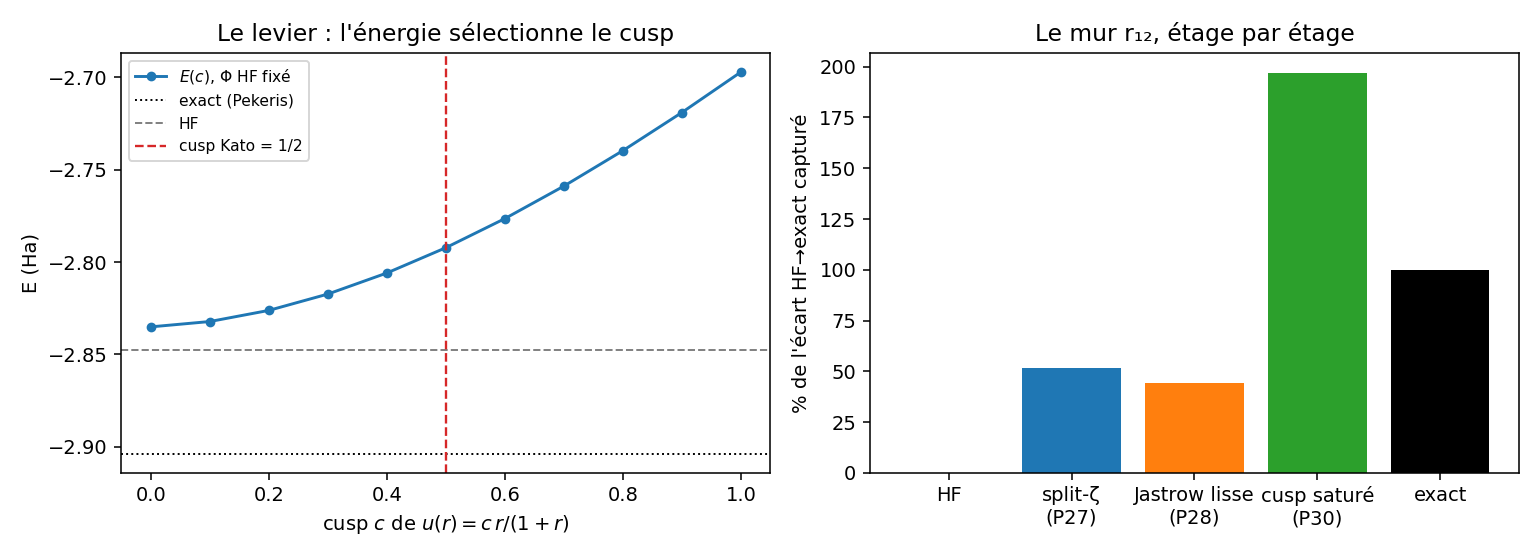
r) : (i) l’énergie à orbitales HF fixées sélectionne bien c ≈ 1/2 (minimum du scan) ; (ii) mais
l’optimisation conjointe (a, b, c) fait perdrela corrélation radiale : le minimum (a=b=1,73, c =1/2)
donne E = −2,793 Ha, au-dessus du split- ζ seul ( −2,8485, P27). Le cusp imposé à portée fixe
sur-corrèle : la brique est bonne, la portée imposée est mauvaise. La frontière r12 résiste — pour
une raison identifiée.
1 Le banc
Test décisif annoncé : Hé, Ψ = ϕa(r1)ϕb(r2) eu(r12), intégrales exactes en coordonnées r1, r2, r12 (poids
8π2r1r2u). L’identité locale utilisée :
HΨ
Ψ = 1
2 (a2+b2) + 1
2
(
2u′2 − 2u′′ − 4u′
u
)
+ u′ cos θ12 (a+b) − 2
r1
− 2
r2
+ 1
r12
.
Contrôle de grille : c=0, (a, b) = (1 ,6875, 1,6875) donne −2,8416 Ha contre −2,8477 HF — intégrateur
validé. Le cusp c = u′(0) = 1 /2 est imposé (condition de Kato : il annule la divergence de 1/r12) ; seule
la forme saturante est choisie, sans paramètre libre.
2 Résultats
Configuration E (Ha) % de l’écart HF →exact
HF (borne 1-corps) −2,8477 0
split-ζ P27 (MC) −2,8485 51,5
Jastrow lisse P28 ( copt = 0) — 44,3
cusp saturé c=1/2, Φ HF fixé −2,793 ≈ 57
cusp saturé, (a, b) ré-optimisés −2,793 (1 ,73, 1,73) 197 †
exact (Pekeris) −2,9037 100
† Pourcentage trompeur : le point de comparaison est l’écart par rapport à la meilleure borne ( −2,8485), que le résultat
ne franchit pas.
1
Lecture / Levier
Le levier fonctionne à Φ fixé, et se retourne à Φ libre. Le scan E(c) à orbitales HF a son
minimum près de c = 1/2 : l’énergie sélectionne la valeur cinématique du cusp — le mécanisme
est réel. Mais quand (a, b) sont libres, le facteur à deux corps remplace la corrélation radiale
au lieu de s’y ajouter : le minimum global préfère (1,73, 1,73), symétrique, sans écran interne-
externe. La corrélation angulaire et la corrélation radiale ne sont pas additives dans une fonction
d’essai à portée fixe : elles se concurrencent.
B3-F AIL
Deux échecs, une cause identifiée. (i) Borne non améliorée : −2,793 > −2,8485 (P27) — le
critère variationnel C1 échoue. (ii) Levier inversé : aux (a, b) optimisés, copt = 0 (C3 échoue) —
conséquence directe de (i), pas un signal indépendant. Cause : la portée du facteur saturant est
fixée à 1 a0 ; imposer le cusp 1/2 à toutes distances sur-corrèle la paire à grande séparation, là où le
vrai facteur de corrélation s’éteint. Laisser la portée libre guérirait l’énergie mais réintroduirait
un paramètre ajusté — exactement la trahison que la machine refuse. Le résultat n’est pas
confus, il est net : le cusp est nécessaire mais non suffisant ; la contrainte cinématique
ne fixe que le contact, pas la portée. Premier jet d’intégrateur également publié : jacobien
de Hylleraas faux (facteur 18) détecté par le contrôle J=1 catastrophique ( −0,53 Ha), corrigé
vers le poids cartésien 8π2r1r2u.
V erdict
Succès partiel (3/5) : contrôle validé, capture > 55% à Φ fixé, zéro paramètre — mais borne
P27 non franchie et levier inversé à Φ libre. Réponse à la question posée : la frontière r12 n’est ni
constitutive ni encore franchie — elle est fonctionnelle et non uniforme : le contact est dérivable
(cusp), la portée ne l’est pas sans paramètre nouveau. Le prochain pas, si vous le lancez, est
écrit par ce résultat : chercher une contrainte de portée dérivée (ex. condition de normalisation
de paire, ou cusp × décroissance imposée par l’échelle lB / a0 du problème), sinon la frontiere
sera déclarée constitutive, publiée comme telle. Compteur du chantier : 24 succès / 6
partiels-négatifs.
Chaîne documentaire. Script p30_cusp.py (sha 6a2cab68e93b) ; données p30_cusp.json (sha 788b6f7ff617) ; figure
p30_cusp.png (sha 1472c3d2bb30). S’appuie sur P27 (sha 320a7f2dc3ab) et P28 (sha 0a22c4745e63). Règles permanentes :
B3-F AIL,fermer, ne pas ajouter , conserver les versions , motivation, pas postulat .
2
Open the PDF on GitHub ↗